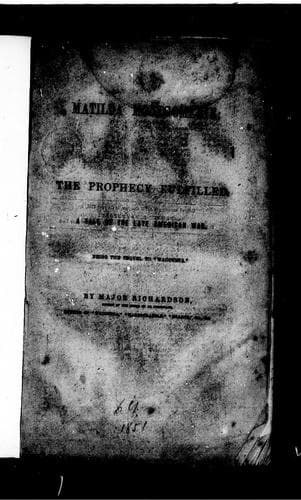
Matilda Montgomerie; Or, The Prophecy FulfilledRichardson, Major (John)
History
Matilda Montgomerie; Or, The Prophecy Fulfilled
Richardson, Major (John)
United States -- History -- War of 1812 -- Fiction
The former with his thoughts evidently far away from the
passing scene, the latter joining in the criticisms on Raymond.
A few moments afterwards Colonel D'Egville entered the room, now
deserted save by the little coterie near the fire-place. Like Lieutenant
Raymond's, his dress was more suited to the bivouac than the ball-room,
and his countenance otherwise bore traces of fatigue.
His daughters flew to meet him. The officers also grouped around,
desirous to hear what tidings he brought of the enemy, to corroborate
the statement of Raymond. To the great mortification of the latter, it
was now found that he and his little detachment had had all the running
to themselves, and that, while they fancied the whole of the American
army to be close at their heels, the latter had been so kept in check by
the force of Indians, under Colonel D'Egville in person, as to be
compelled to retire upon the point whence the original attack had been
made. They had not followed the broken English outpost more than a mile,
and yet, so convinced of close pursuit had been the latter, that for the
space of six leagues they had scarce relaxed in their retreat. The
information now brought by Colonel D'Egville was, that the Americans had
not advanced a single foot beyond the outpost in question, but, on the
contrary, had commenced constructing a stockade and throwing up
entrenchments. He added, moreover, that he had just dispatched an
express to Sandwich, to General Proctor, communicating the intelligence,
and suggesting the propriety of an attack before they could advance
farther, and favor any movement on the part of the inhabitants of
Detroit. As this counter-movement on our part would require every man
that could be spared from the latter fortress, Colonel D'Egville seemed
to think that before the officers could reach it, its garrison would be
already on the way to join the expedition, which would doubtless be
ordered to move from Amherstburg; and as the same impression appeared to
exist in the mind of Colonel St. Julian, whom he had only just parted
from to proceed in search of his daughters, the latter had taken it upon
himself to determine that they should remain where they were until the
answer, communicating the final decision of General Proctor, should
arrive.
Public-domain text, read in full here on John Shaqi.
Reviews
Reviews
No reviews yet
Be the first to share your thoughts on this work.
Elsewhere in the archive
Join the Discussion
Join the discussion
Sign in to leave a comment or review.
Sign InorCreate an account