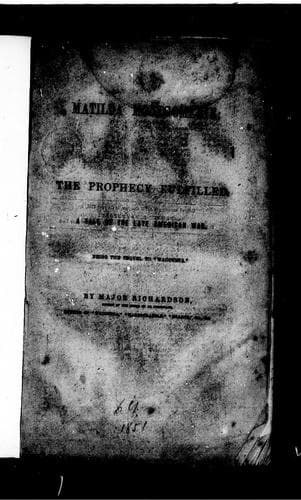
Matilda Montgomerie; Or, The Prophecy FulfilledRichardson, Major (John)
History
Matilda Montgomerie; Or, The Prophecy Fulfilled
Richardson, Major (John)
United States -- History -- War of 1812 -- Fiction
Gerald saw that he was deeply pained; and, impatient and angry with
himself, he also rose and paced the room with hurried steps. At length
he stopped, and putting one hand upon the shoulder of his brother, who
stood gazing vacantly from the window, pointed with the other towards
that part of the apartment in which both their parents had breathed
their last.
"Henry, my kind, good Henry," he said, with a voice faltering with
emotion, "do you recollect the morning when, on our return from school,
we found our young holiday joy changed into heart-breaking and mourning
by the sight of our dying mother?"
"Remember it, Gerald! aye, even as though it had been yesterday. Oh, my
brother, little did I think at the moment when, with hands closely
clasped together, we sank, overcome with grief, upon our bended knees,
to receive that mother's blessing, a day would ever arrive when the joy
or sorrow of the one should form no portion of the joy or sorrow of the
other."
"It was there," pursued Gerald, and without noticing the interruption,
"that we solemnly pledged ourselves to do the will and bidding of our
father in all things."
"Even so, Gerald, I remember it well."
"And it was there," continued the sailor, with the emphasis of strong
emotion, "that, during my unfortunate absence from the death-bed of our
yet surviving parent, you gave a pledge for _both_, that no action of
our lives should reflect dishonor on his unsullied name."
"I did. Both in your name and in my own, I gave the pledge--well knowing
that, in that, I merely anticipated your desire."
"Most assuredly; what then would be your sensations were you to know
that I had violated that sacred obligation?"
"Deep, poignant, ceaseless regret, that my once noble and high-spirited
brother should have been so lost to respect for his father's memory and
for himself." This was uttered not without deep agitation.
"You are right, Henry," added Gerald, mournfully; "better, far better,
is it to die than live on in the consciousness of having forfeited all
claim to esteem."
The young soldier started as if a viper had stung him. "Gerald," he
said, eagerly, "you have not dishonored yourself. Oh no--tell me, my
brother, that you have not."
"No," was the cold, repulsive answer; "although my peace of mind is
fled," he pursued, rather more mildly, "my honor, thank heaven, remains
as pure as when you first pledged yourself for its preservation."
"Thanks, my brother, for that. But can it really be possible, that the
mysterious condition attached to Miss Montgomerie's love involves the
loss of honor?"
Gerald made no answer.
"And can _you_ really be weak enough to entertain a passion for a woman,
who would make the dishonoring of the fair fame of him she professes to
love the fearful price at which her affection is to be purchased?"
Gerald seemed to wince at the word "weak," which was rather emphatically
pronounced, and looked displeased at the concluding part of the
sentence.
Public-domain text, read in full here on John Shaqi.
Reviews
Reviews
No reviews yet
Be the first to share your thoughts on this work.
Elsewhere in the archive
Join the Discussion
Join the discussion
Sign in to leave a comment or review.
Sign InorCreate an account