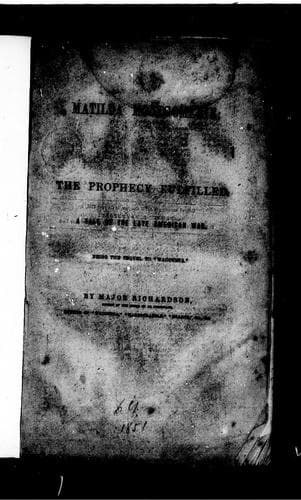
Matilda Montgomerie; Or, The Prophecy FulfilledRichardson, Major (John)
History
Matilda Montgomerie; Or, The Prophecy Fulfilled
Richardson, Major (John)
United States -- History -- War of 1812 -- Fiction
"I said not that the condition attached to her _love_," he remarked,
with the piqued expression of a wounded vanity; "her affection is mine,
I know, beyond her own power of control--the condition relates not to
her heart, but to her hand."
"Alas, my poor infatuated brother. Blinding indeed must be the delusions
of passion, when a nature so sensitive and so honorable shrinks not from
such a connexion. My only surprise is, that, with such a perversion of
judgment you have returned at all."
"No more of this Henry. It is not in man to control his destiny, and
mine appears to be to love with a fervor that must bear me, ere long, to
my grave. Of this, however, be assured--that, whatever my weakness, or
infatuation, as you may be pleased to call it, _that_ passion shall
never be gratified at the expense of my honor. Deeply--madly as I doat
upon her image, Miss Montgomerie and I have met for the last time."
Overcome by the emotion with which he had thus expressed himself, Gerald
could not restrain a few burning tears that forced their way down his
hollow cheeks. Henry caught eagerly at this indication of returning
softness, and again essayed, in reference to the concluding declaration
of his brother, to urge upon him the unworthiness of her who had thus
cast her deadly spell upon his happiness. But Gerald could ill endure
the slightest allusion to the subject.
"Henry," he said, "I have already told you that Miss Montgomerie and I
have parted for ever; but not the less devotedly do I love her. If,
therefore, you would not farther wring a heart already half broken with
affliction, oblige me by never making the slightest mention of her name
in my presence--or ever adverting again to our conversation of this
morning. I am sure, Henry, you will not deny me this."
Henry offered no other reply than by throwing himself into the arms that
were extended to receive him. The embrace of the brothers was long and
fervent, and, although there was perhaps more of pain than pleasure, in
their mutual sense of the causes which had led to it in the present
instance--still was it productive of a luxury the most heartfelt. It
seemed to both as if the spirits of their departed parents hovered over,
and blessed them in this indication of their returning affection,
hallowing, with their invisible presence, a scene connected with the
last admonitions from their dying lips. When they had thus given vent to
their feelings, although the sense of unhappiness continued
undiminished, their hearts experienced a sensible relief; and when they
separated for the morning, in pursuit of their respective avocations, it
was with a subdued manner on the part of Gerald, and a vague hope with
Henry, that his brother's disease would eventually yield to various
influences, and that other and happier days were yet in store for both.
CHAPTER XXII.
Public-domain text, read in full here on John Shaqi.
Reviews
Reviews
No reviews yet
Be the first to share your thoughts on this work.
Elsewhere in the archive
Join the Discussion
Join the discussion
Sign in to leave a comment or review.
Sign InorCreate an account