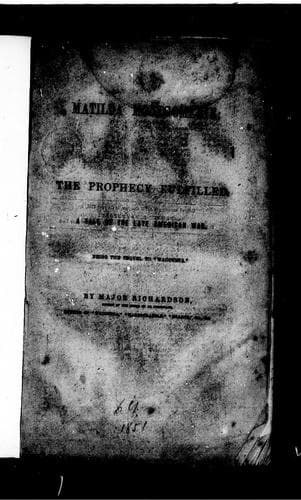
Matilda Montgomerie; Or, The Prophecy FulfilledRichardson, Major (John)
History
Matilda Montgomerie; Or, The Prophecy Fulfilled
Richardson, Major (John)
United States -- History -- War of 1812 -- Fiction
Gerald meanwhile, finding victory declare itself in favor of his
companion, had followed his example and entered the hut with his saddle.
As he again quitted it, a sudden flash of light from the fire, which
Jackson was then in the act of stirring, fell upon the countenance of
the woodsman who stood without, his arms folded and his brow scowling,
as if planning some revenge for the humiliation to which he had been
subjected. In the indistinct dusk of the evening Grantham had not been
able to remark more than the outline of the figure; but the voice struck
him as one not unknown to him, although somewhat harsher in its tones
than that which his faint recollection of the past supplied. The glance
he had now obtained, momentary as it was, put every doubt to rest. What
his feelings were in recognising in the woodsman the traitor settler of
the Canadas, Jeremiah Desborough, we leave to our readers to infer.
CHAPTER XXV.
There was a time, when to have met his father's enemy thus would have
been to have called into activity all the dormant fierceness of Gerald's
nature; but since they had last parted, a new channel had been opened to
his feelings, and the deep and mysterious grief in which we have seen
him shrouded had been of so absorbing and selfish a nature, as to leave
him little consideration for sorrows not his own. The rash impetuosity
of his former character, which had often led him to act even before he
thought, and to resent an injury before it could well be said to have
been offered, had moreover given place to a self-command, the fruit of
the reflective habits and desire of concealment which had made him
latterly almost a stranger to himself.
Whatever his motives for outwardly avoiding all recognition of the
settler, certain it is that, so far from this, he sought sedulously to
conceal his own identity, by drawing the slouched hat, which formed a
portion of his new equipment, lower over his eyes. Left to do the duties
of the rude hostelry, Captain Jackson and he now quitted the hut, and
leading their jaded, smoking steeds, a few rods off to the verge of the
plain they had so recently traversed, prepared to dispose of them for
the night. Gerald had by this time become too experienced in the mode of
travelling through an American wilderness, not to understand, that he
who expects to find a companion in his horse in the morning must duly
secure him with the tether at night. Following, therefore, the example
of the Aide-de-camp, he applied himself, amid the still pelting rain, to
the not very cleanly task of binding round the fetlock joints of his
steed several yards of untanned hide strips, with which they were
severally provided for the purpose. Each gave his steed a parting slap
on the buttock with the hard bridle. Jackson exclaiming, "Go ye
luxurious beasts--ye have a whole prairie of wet grass to revel in for
the night," and then left them to make the best of their dainty food.
Public-domain text, read in full here on John Shaqi.
Reviews
Reviews
No reviews yet
Be the first to share your thoughts on this work.
Elsewhere in the archive
Join the Discussion
Join the discussion
Sign in to leave a comment or review.
Sign InorCreate an account