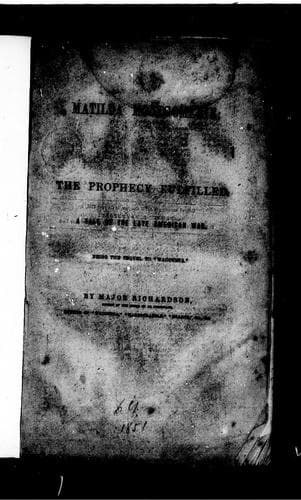
Matilda Montgomerie; Or, The Prophecy FulfilledRichardson, Major (John)
History
Matilda Montgomerie; Or, The Prophecy Fulfilled
Richardson, Major (John)
United States -- History -- War of 1812 -- Fiction
While returning, Grantham took occasion to observe, that he had reason
to think he knew the surly and inhospitable woodsman, by whom however he
was not desirous of being recognised, and therefore begged as a favor
that Captain Jackson would not, in the course of the night, mention his
name, or even allude to him in any way that could lead to an inference
that he was any other than he seemed, a companion and brother officer of
his own; promising, in conclusion, to give him, in the course of the
next day's journey, some little history of the man which would fully
explain his motives. With this request Jackson unhesitatingly promised
compliance, adding, good-humoredly, that he was not sorry to pledge
himself to anything that would thaw his companion's tongue into
sociability, and render himself, for the first time since their
departure, a listener. Before entering the hut Gerald further observed
in a whisper that, the better to escape recognition, he would, as much
as possible, avoid joining in any conversation which might ensue, and
therefore hoped his companion would not think him rude if he suffered
him to bear the tax. Jackson again promised to keep the attention of the
woodsman directed as much as possible to himself, observing that he
thought Gerald had already, to his cost, discovered he was one not
easily tired out by conversation, should their host be that way
inclined.
On opening the door of the cabin, they found that the woodsman--or more
properly the settler, as we shall again term him--making a virtue of
necessity, had somewhat changed its interior. A number of fine logs,
sufficient to last throughout the night had been heaped upon the hearth,
and these, crackling and fizzing, and emitting sparks in all the burly
of a hickory wood fire, gave promise of a night of comparative comfort.
Ensconced in the farther corner of the chimney, the settler had already
taken his seat, and, regardless of the entrance of the strangers, (with
his elbows resting on his knees, and his face buried in his large
palms,) kept his eyes fixed upon the fire, as if with a sullen
determination neither to speak nor suffer himself to be questioned. But
the Aide-de-camp was by no means disposed to humor him in his fancy. The
idea of passing some eight or ten consecutive hours in company with two
fellow beings, without calling into full play the bump of loquacity with
which nature had largely endowed him, was, in his view, little better
than the evil from which his perseverance had just enabled him to
escape. Making himself perfectly at home, he unbuckled the wet blanket
from his loins and spreading it, with that of Gerald, to dry upon the
rude floor before the fire, drew forward a heavy uncouth-looking table,
(which, with two or three equally unpolished chairs, formed the whole of
the furniture,) and deposited thereon the wallet or haversack in which
remained a portion of provision. He then secured the last vacant chair,
Public-domain text, read in full here on John Shaqi.
Reviews
Reviews
No reviews yet
Be the first to share your thoughts on this work.
Elsewhere in the archive
Join the Discussion
Join the discussion
Sign in to leave a comment or review.
Sign InorCreate an account