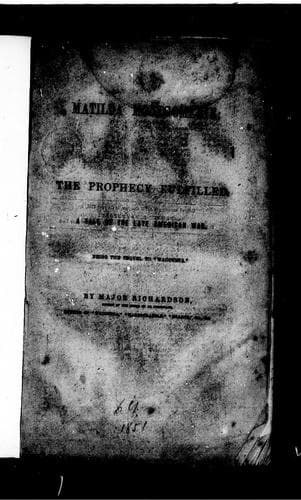
Matilda Montgomerie; Or, The Prophecy FulfilledRichardson, Major (John)
History
Matilda Montgomerie; Or, The Prophecy Fulfilled
Richardson, Major (John)
United States -- History -- War of 1812 -- Fiction
"Nay, Liftenant Grantham," said the Aid-de-camp, who had again resumed
his burden, and was speedily at the side of his companion, "don't be
offended. I've no doubt the thing's as you say; but you must make
allowance for my ideas, never too much of the brightest, being
conglomerated, after a fashion, by what I have seen and heard, since we
let loose our horses last night upon this prairie."
"I am not offended, only hurt," replied Gerald, shaking the hand that
was cordially tendered to him, "hurt, that you should doubt my word, or
attach anything to the assertion of that man beyond the mere ravings of
a savage and diseased spirit. Justice to myself demands that I should
explain everything in detail."
"Now, that's what I call all right and proper," returned the
Aide-de-camp, "and should be done, both for your sake and mine; but we
will leave it till we get once more upon the road and in sight of a
tavern, for it's dry work talking and listening without even so much as
a gum tickler of the Wabash to moisten one's clay."
They found their horses not far from the spot where they had been left
on the preceding night, and these being speedily untethered and saddled,
the travellers again pursued their route towards the capital of the
state in which they found themselves. As they passed the hut which had
been the scene of so much excitement to both, the voice of Desborough,
whom they had left fast asleep, was heard venting curses and
imprecations upon them both, for having left him there to starve, bound
and incapable of aiding himself. Wretch as the settler was, Gerald could
not reconcile to himself the thought of his being left to perish thus
miserably, and he entreated the Aid-de-camp to enter and divide the
cords. But Jackson declared this to be impolitic, urging as a powerful
reason for declining, the probability of his having fire-arms in the
hut, with which (if released) he might follow and overtake them in their
route, and sacrifice one or the other to his vengeance--an object which
it would be easy to accomplish without his ever being detected. However,
that the villain might have sustenance until some chance traveller
should come later to his assistance, or he could manage to get rid of
his bonds himself, he consented to place within his reach all the dried
meat that had been left of his Indian foes, together with a pail of
water--the latter by way of punishment for having swilled away at his
Wabash in the ungracious manner he had.
Public-domain text, read in full here on John Shaqi.
Reviews
Reviews
No reviews yet
Be the first to share your thoughts on this work.
Elsewhere in the archive
Join the Discussion
Join the discussion
Sign in to leave a comment or review.
Sign InorCreate an account