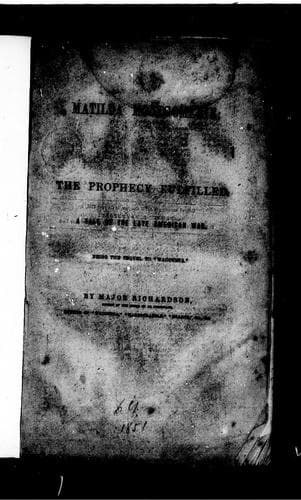
Matilda Montgomerie; Or, The Prophecy FulfilledRichardson, Major (John)
History
Matilda Montgomerie; Or, The Prophecy Fulfilled
Richardson, Major (John)
United States -- History -- War of 1812 -- Fiction
While Jackson was busied in this office of questionable charity, the
rage and disappointment of the settler surpassed what it had hitherto
been. Each vein of his dark brow rose distinctly and swelling from its
surface, and he kicked and stamped with a fury that proclaimed the
bitter tempest raging in his soul. When the Aide-de-camp had again
mounted, his shrieks and execrations became piercing, and for many
minutes after they had entered into the heart of the forest in which the
hut was situated, the shrill sounds continued to ring upon their ears in
accents so fearful, that each felt a sensible relief when they were
heard no more.
On the evening of the third day after this event, Jackson and our hero,
between whom a long explanation on the subject of the settler had taken
place, alighted at the door of the principal inn in Frankfort, the
capital of Kentucky, which was their ultimate destination. To mine host
Gerald was introduced by his escort with the formality usual on such
occasions in America, and with the earnest recommendation to that most
respectable personage, that, as his own friend, as well as that of
Captain Forrester, every indulgence should be shown to the prisoner that
was not inconsistent with his position.
CHAPTER XXVI.
Few situations in life are less enviable than that of the isolated
prisoner of war. Far from the home of his affections, and compelled by
the absence of all other companionship, to mix with those who, in
manners, feelings, and national characteristics, form, as it were, a
race apart from himself, his recollections, already sufficiently
embittered by the depressing sense of captivity, are hourly awakened by
some rude contrast wounding to his sensibilities, and even though no
source of graver irritation should exist, a thousand petty annoyances,
incident to the position, are magnified by chagrin from mole-hills into
mountains. Such, however, would be the effect produced on one only, who,
thrown by the accident of war into the situation of a captive, should
have no grief more profound, no sorrow deeper seated, than what arose
from the being severed from old, and associated with new and undesired
ties--one to whom life was full of the fairest buds of promise, and
whose impatience of the present was only a burning desire to enter upon
the future. Not so with Gerald Grantham. Time, place, circumstance,
condition, were alike the same--alike indifferent to him. In the
recollection of the scenes he had so lately quitted, and in which his
fairer and unruffled boyhood had been passed, he took no pleasure--while
the future was so enshrouded in gloom, that he shrank from its very
contemplation. So far from trying to wring consolation from
circumstances, his object was to stupify recollection to the uttermost.
He would fain have shut out both the past and the future, contenting
himself as he might with the present; but the thing was impossible. The
worm had eaten into his heart, and its gnawings were too painful, not
Public-domain text, read in full here on John Shaqi.
Reviews
Reviews
No reviews yet
Be the first to share your thoughts on this work.
Elsewhere in the archive
Join the Discussion
Join the discussion
Sign in to leave a comment or review.
Sign InorCreate an account