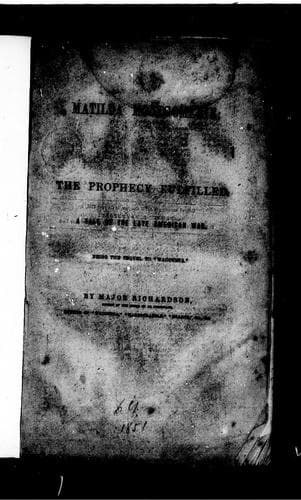
Matilda Montgomerie; Or, The Prophecy FulfilledRichardson, Major (John)
History
Matilda Montgomerie; Or, The Prophecy Fulfilled
Richardson, Major (John)
United States -- History -- War of 1812 -- Fiction
There was no reply, although the same looks of surprise were
interchanged; but, as he continued to glance his eye around the circle,
it encountered, either by accident or design, that of Captain Molineux,
on whose rather confused countenance the gaze of Henry Grantham was at
that moment bent with an expression of much meaning.
"No one answers," continued the youth; "then the sting has been
harmless. But I crave your pardon, General--I am claiming an exemption
from censure which may not be conceded by all. Commodore, how shall I
dispose of my prisoners?"
"Not so, Mr. Grantham; you have sufficiently established your right to
repose, and I have already issued the necessary instructions. Yet, while
you have nobly acquitted yourself of _your_ duty, let me also perform
_mine_. Gentlemen," he continued, addressing the large circle of
officers, "I was the first to comment on Mr. Grantham's supposed neglect
of duty, and to cast a doubt on his fidelity. That I was wrong I admit,
but right I trust will be my reparation, and whatever momentary pain he
may experience in knowing that he has been thus unjustly judged, it
will, I am sure, be more than compensated for, when he hears that by
General Brock himself his defence was undertaken, even to the pledging
of his own honor. Mr. Grantham," concluded the gallant officer, "how you
have obtained your knowledge of the conversation that passed here during
your absence, is a mystery I will not now pause to inquire into, but I
would fain apologize for the wrong I have done. Have I your pardon?"
At the commencement of this address, the visible heaving of his full
chest, the curling of his proud lip, and the burning flush of his dark
cheek, betrayed the mortification Gerald felt, in having been placed in
a position to be judged thus unjustly; but, as the commodore proceeded,
this feeling gradually passed away, and when the warm defence of his
conduct by the general was alluded to, closed as the information was
with a request for pardon, his temporary annoyance was banished, and he
experienced only the generous triumph of one who is conscious of having
won his way, through calumny and slander, to the well merited
approbation of all right minded men.
"Come, come," interposed the general, more touched than he was willing
to appear, by the expressive manner in which the only hand of the
commodore now grasped that of his lieutenant, and perceiving that the
latter was about to reply--"We will defer all further explanation until
a later period. But, before we depart, this person must be disposed of;
Major Montgomerie, excuse my asking if you will be personally
responsible for your fellow prisoner?"
"Certainly not!" returned the Major quickly, and with something like
alarm at the required responsibility; "that is to say, he does not
belong to the United States regular service, and I know nothing of him.
Indeed, I never saw him before last night, when he joined me with a
verbal message from Detroit."
Public-domain text, read in full here on John Shaqi.
Reviews
Reviews
No reviews yet
Be the first to share your thoughts on this work.
Join the Discussion
Join the discussion
Sign in to leave a comment or review.
Sign InorCreate an account