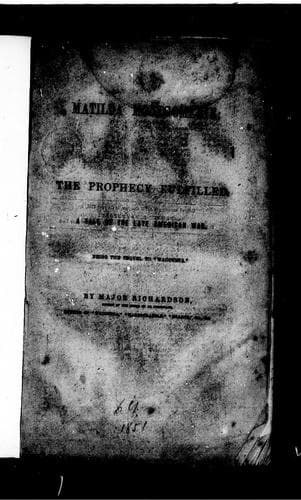
Matilda Montgomerie; Or, The Prophecy FulfilledRichardson, Major (John)
History
Matilda Montgomerie; Or, The Prophecy Fulfilled
Richardson, Major (John)
United States -- History -- War of 1812 -- Fiction
Thus far the view to the right of the spectator, whom we assume to be
facing the river. Immediately opposite to the covering demi-lune, and in
front of the fort, appeared, at a distance of less than half a mile, a
blockhouse and battery, crowning the western extremity of the island of
Bois Blanc, one mile in length, and lashed at its opposite extremity by
the waters of Lake Erie, which, at this precise point receives into her
capacious bosom the vast tribute of the noble river connecting her with
the higher lakes. Between this island and the Canadian shore lies the
only navigable channel for ships of heavy tonnage, for although the
waters of the Detroit are of vast depth every where above the island,
they are near their point of junction with the lake, and, in what is
called the American channel, so interrupted by shallows and sandbars,
that no craft larger than those of a description termed "Durham boats,"
can effect the passage--on the other hand the channel dividing the
island from the Canadian shore is at once deep and rapid, and capable of
receiving vessels of the largest size. The importance of such a passage
was obvious; but although a state of war necessarily prevented aid from
armed vessels to such forts of the Americans as lay to the westward of
the lake, it by no means effectually cut off their supplies through the
medium of the Durham boats already alluded to. In order to intercept
those, a most vigilant watch was kept by the light gun boats despatched
into the lesser channel for that purpose.
A blockhouse and battery crowned also the eastern extremity of the
island, and both, provided with a flagstaff for the purpose of
communication by signal with the fort, were far from being wanting in
picturesque effect. A subaltern's command of infantry, and a
bombvadier's of artillery, were the only troops stationed there, and
these were rather to look out for and report the approach of whatever
American boats might be seen stealing along their own channel, than with
any view to the serious defence of a post already sufficiently commanded
by the adjacent fortress. In every other direction the island was
thickly wooded--not a house, not a hut arose, to diversify the wild
beauty of the scene. Frequently, it is true, along the margin of its
sands might be seen a succession of Indian wigwams, and the dusky and
sinewy forms of men gliding round their fires, as they danced to the
monotonous sound of the war dance; but these migratory people seldom
continuing long in the same spot, the island was again and again left to
its solitude.
Public-domain text, read in full here on John Shaqi.
Reviews
Reviews
No reviews yet
Be the first to share your thoughts on this work.
Join the Discussion
Join the discussion
Sign in to leave a comment or review.
Sign InorCreate an account