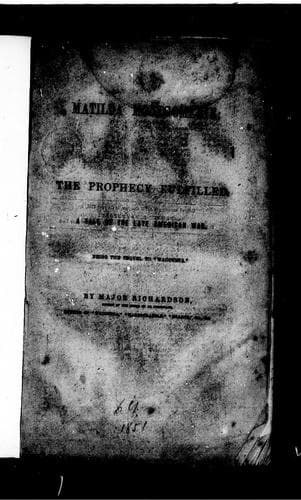
Matilda Montgomerie; Or, The Prophecy FulfilledRichardson, Major (John)
History
Matilda Montgomerie; Or, The Prophecy Fulfilled
Richardson, Major (John)
United States -- History -- War of 1812 -- Fiction
"The best of the adventure remains, however, to be told. Numbers of the
peasantry from either shore, provided with poles, guns, and ropes, were
now to be seen rushing towards the half congealed Cranstoun, fully
imagining--nay exclaiming--that it was a wild bear, which, in an attempt
to cross the river, had had its retreat cut off, and was now, from
insensibility, rendered harmless. Disputes even arose in the distance as
to whom the prize should belong, each pursuer claiming to have seen it
first. Nay, more than one gun had been levelled with a view of
terminating all doubt by lodging a bullet in the carcase, when,
fortunately, for the subject in dispute, this proposal was overruled by
the majority, who were more anxious to capture than to slay the supposed
bear. Meanwhile the Canadian, harnessed to the sleigh of the D'Egvilles,
roared out with all his lungs for the two parties to hasten to the
assistance of the drowning British officer. In the confusion produced by
their own voices, however, they did not appear to hear or understand
him; yet all pursued the aim they had in view. Cranstoun's body was so
doubled up that it was impossible for any one, who had not witnessed the
accident, to imagine it anything in nature but a bear; and this
impression, the strange moaning he continued to make, tended to
confirm.
"The party of Canadians, favored by the nature of their floating
ice-bridges, were the first to come up to him. A desperate effort of his
cramped muscles had enabled Cranstoun to extend one of his legs, at the
moment when they were about to throw a noose round his neck, and this
was the first intimation the astonished peasantry had of their supposed
prize being a human being, instead of the fat bear they had expected.
Poor Cranstoun was of course liberated from his 'durance vile,' but so
chilled from long immersion, that he could not stand without assistance,
and it was not until one of their companions had approached with a
sleigh that he could be removed. He kept his bed three days, as much I
believe from vexation as illness, and has never worn his unlucky bear
skin since; neither has he forgiven Julia D'Egville the laugh she
enjoyed at his expense. Cranstoun," he concluded, "you may turn now, the
story is told."
But Cranstoun, apparently heedless of the laugh that followed this--as
indeed it did every--narration of the anecdote, was not to be shaken
from his equanimity. He continued silent and unmoved, as if he had not
heard a word of the conclusion.
"Poor Cranstoun," exclaimed the joyous De Courcy, in a strain of
provoking banter, "what an unfortunate leap that was of yours; and how
delighted you must have felt when you again stepped on terra firma."
"I don't wonder at his leap being unfortunate," observed Middlemore, all
eyes fixed upon him in expectation of what was to follow, "for Julia
D'Egville can affirm that, while paying his court to her, he had not
chosen a _leap year_."
Public-domain text, read in full here on John Shaqi.
Reviews
Reviews
No reviews yet
Be the first to share your thoughts on this work.
Join the Discussion
Join the discussion
Sign in to leave a comment or review.
Sign InorCreate an account