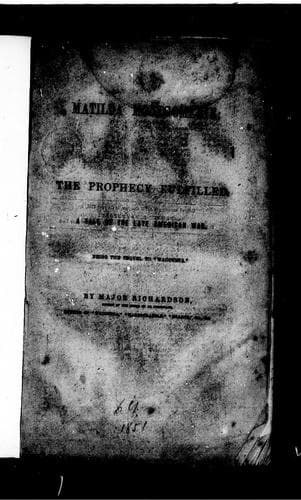
Matilda Montgomerie; Or, The Prophecy FulfilledRichardson, Major (John)
History
Matilda Montgomerie; Or, The Prophecy Fulfilled
Richardson, Major (John)
United States -- History -- War of 1812 -- Fiction
The half hour that elapsed between the arrival of the several guests and
the announcement of dinner, was passed under the influence of feelings
almost as various in kind as the party itself. Messieurs Split-rock,
Round-head, and Walk-in-the-water, fascinated by the eagles on the
buttons of Major Montgomerie's uniform, appeared to regard that officer
as if they saw no just cause or impediment why certain weapons dangling
at their sides should not be made to perform, and that without delay, an
incision into the cranium of their proprietor. True, there was a
difficulty. The veteran major was partially bald, and wanted the top
knot or scalping tuft, which to a true warrior was indispensable; not
that we mean to insinuate, that either of these chiefs would so far have
forgotten the position in which that gentleman stood, as to have been
tempted into any practical demonstration of hostility: but there was a
restlessness about the eye of each, that--much like the instinct of the
cat, which regards with natural avidity the bird that is suffered to go
at large within his reach, without daring openly to attack it--betrayed
the internal effort it cost them to lose sight of the enemy in the
prisoner and friend of the superintendent. The major, on the other hand,
although satisfied he was under the roof of hospitality, did not at
first appear altogether at his ease, but, while he conversed with the
English officers, turned ever and anon an eye of distrust on the
movements of his swarthy fellow guests. On the arrival of Tecumseh, who,
detained until a late hour by the arrangements he had been making for
the encampment and supplies of his new force, was the last to make his
appearance, the major's doubts passed entirely away. It was impossible
to be in the presence of this chieftain, and fail, even without any
other index to his soul than what the candor of his expression afforded,
to entertain all the security that man may repose on man. He had in him,
it is true, too much of the sincerity of nature, to make anything like a
friendly advance to one of a people on whom he charged all the
misfortunes of his race, and for whom he had avowed an inextinguishable
hostility of heart and purpose; but, unless when this might with strict
propriety be exercised, the spirit of his vengeance extended not; and
not only would he have scorned to harm a fallen foe, but his arm would
have been the first uplifted in his defence.
Public-domain text, read in full here on John Shaqi.
Reviews
Reviews
No reviews yet
Be the first to share your thoughts on this work.
Join the Discussion
Join the discussion
Sign in to leave a comment or review.
Sign InorCreate an account