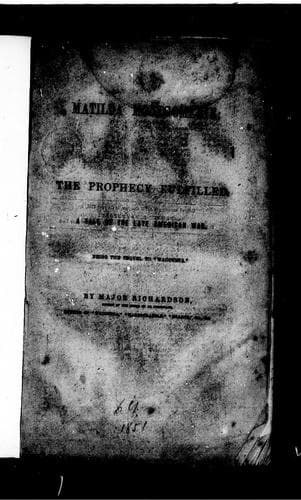
Matilda Montgomerie; Or, The Prophecy Fulfilled — John Shaqi
Matilda Montgomerie; Or, The Prophecy FulfilledRichardson, Major (John)
History
Matilda Montgomerie; Or, The Prophecy Fulfilled
Richardson, Major (John)
United States -- History -- War of 1812 -- Fiction
It was a novel and beautiful sight to behold that imposing fleet of
canoes, apparently so frail in texture that the dropping of a pebble
between the skeleton ribs might be deemed sufficient to perforate and
sink them, yet withal so ingeniously contrived as to bear safely not
only the warriors who formed their crews, but also their arms of all
descriptions, and such light equipment of raiment and necessaries as
were indispensable to men who had to voyage long and far in pursuit of
the goal they were now rapidly attaining. The Indians already encamped
near the fort, were warriors of nations long rendered familiar by
personal intercourse, not only with the inhabitants of the district, but
with the troops themselves; and these, from frequent association with
the whites, had lost much of that fierceness which is so characteristic
of the North American Indian in his ruder state. Among these, with the
more intelligent Hurons, were the remnants of those very tribes of
Shawnees and Delawares whom we have recorded to have borne, half a
century ago, so prominent a share in the confederacy against England,
but who, after the termination of that disastrous war, had so far
abandoned their wild hostility, as to have settled in various points of
contiguity to the forts to which they, periodically, repaired to receive
those presents which a judicious policy so profusely bestowed.
The reinforcement just arriving was composed principally of warriors who
had never yet pressed a soil wherein civilization had extended her
influence--men who had never hitherto beheld the face of a white, unless
it were that of the Canadian trader, who, at stated periods, penetrated
fearlessly into their wilds for purposes of traffic, and who to the
bronzed cheek that exposure had rendered nearly as swarthy as their own,
united not only the language but so wholly the dress--or rather the
undress of those he visited, that he might easily have been confounded
with one of their own dark-blooded race. So remote, indeed, were the
regions in which some of these warriors had been sought, that they were
strangers to the existence of more than one of their tribes, and upon
these they gazed with a surprise only inferior to what they manifested,
when, for the first time, they marked the accoutrements of the British
soldier, and turned with secret, but acknowledged awe and admiration
upon the frowning fort and stately shipping, bristling with cannon, and
vomiting forth sheets of flame as they approached the shore. In these
might have been studied the natural dignity of man. Firm of step--proud
of mien--haughty and penetrating of look, each leader offered in his own
person a model to the sculptor, which he might vainly seek elsewhere.
Free and unfettered every limb, they moved in the majesty of nature, and
with an air of dark reserve, passed, on landing, through the admiring
crowd.
Public-domain text, read in full here on John Shaqi.
Reviews
Reviews
No reviews yet
Be the first to share your thoughts on this work.
Join the Discussion
Join the discussion
Sign in to leave a comment or review.
Sign InorCreate an account