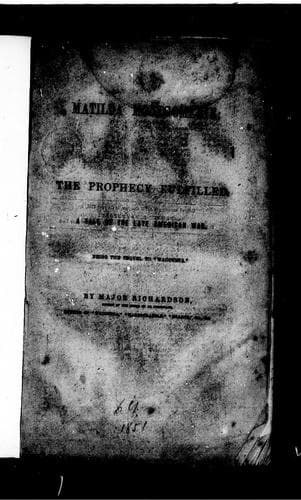
Matilda Montgomerie; Or, The Prophecy FulfilledRichardson, Major (John)
History
Matilda Montgomerie; Or, The Prophecy Fulfilled
Richardson, Major (John)
United States -- History -- War of 1812 -- Fiction
Simon Girty had passed the greater part of his younger days in America.
He had borne arms in the revolution, and was one of those faithful
loyalists, who preferring rather to abandon a soil which, after all, was
one of adoption, than the flag under which they had been nurtured, had,
at the termination of that contest, passed over into Canada. Having
served in one of those irregular corps, several of which had been
employed with the Indians, during the revolutionary contest, he had
acquired much of the language of these latter, and to this knowledge was
indebted for the situation of interpreter which he had for years
enjoyed. Unhappily for himself, however, the salary attached to the
office was sufficient to keep him in independence, and, to the idleness
consequent on this, (for the duties of an interpreter were only
occasional,) might have been attributed the rapid growth of a vice--an
addiction to liquor--which unchecked indulgence had now ripened into
positive disease.
Great was the terror that Simon was wont to excite in the good people of
Amherstburg. With Silvertail at his speed he would gallop into the town,
brandishing his cudgel, and reeling from side to side, exhibiting at one
moment the joyous character of a Silenus, at another, as we have already
shown--that of an inebriated Centaur. Occasionally he would make his
appearance, holding his sides convulsed with laughter, as he reeled and
tottered in every direction, but without ever losing his equilibrium. At
other times he would utter a loud shout, and, brandishing his cudgel,
dart at full speed along the streets, as if he purposed singly to carry
the town by (what Middlemore often facetiously called) a _coup de main_.
At these moments were to be seen mothers rushing into the street to look
for, and hurry away, their loitering offspring, while even adults were
glad to hasten their movements, in order to escape collision with the
formidable Simon; not that either apprehended the slightest act of
personal violence from the old man, for he was harmless of evil as a
child, but because they feared the polished hoofs of Silvertail, which
shone amid the clouds of dust they raised as he passed, like rings of
burnished silver. Even the very Indians, with whom the streets were at
this period habitually crowded, were glad to hug the sides of the
houses, while Simon passed; and they who, on other occasions, would have
deemed it in the highest degree derogatory to their dignity to have
stepped aside at the approach of danger, or to have relaxed a muscle of
their stern countenance, would then open a passage with a rapidity which
in them was remarkable, and burst into loud laughter as they fled from
side to side to make way for Simon. Sometimes, on these occasions, the
latter would suddenly check Silvertail, while in full career, and, in a
voice that could be heard from almost every quarter of the little town,
harangue them for half an hour together in their own language, and with
Public-domain text, read in full here on John Shaqi.
Reviews
Reviews
No reviews yet
Be the first to share your thoughts on this work.
Elsewhere in the archive
Join the Discussion
Join the discussion
Sign in to leave a comment or review.
Sign InorCreate an account