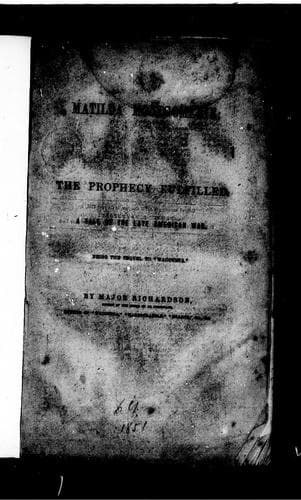
Matilda Montgomerie; Or, The Prophecy FulfilledRichardson, Major (John)
History
Matilda Montgomerie; Or, The Prophecy Fulfilled
Richardson, Major (John)
United States -- History -- War of 1812 -- Fiction
an air of authority that was ludicrous to those who witnessed it--and
must have been witnessed to be conceived. Occasionally a guttural "ugh"
would be responded in mock approval of the speech, but more frequently a
laugh, on the part of the more youthful of his red auditors, was the
only notice taken. His lecture concluded, Simon would again brandish his
cudgel, and vociferate another shout; then betaking himself to the
nearest store, he would urge Silvertail upon the footway, and with a tap
of his rude cudgel against the door, summon whoever was within, to
appear with a glass of his favorite beverage. And this would he repeat,
until he had drained what he called his stirrup cup, at every shop in
the place where the poisonous liquor was vended.
Were such a character to make his appearance in the Mother Country,
endangering, to all perception, the lives of the Sovereign's liege
subjects, he would, if in London, be hunted to death like a wild beast,
by at least one half of the Metropolitan police; and, if in a provincial
town, would be beset by a posse of constables. No one, however--not even
the solitary constable of Amherstburgh, ever ventured to interfere with
Simon Girty, who was in some degree a privileged character. Nay, strange
as it may appear, notwithstanding his confirmed habit of inebriety, the
old man stood high in the neighborhood, not only with simple but with
gentle, for there were seasons when he evinced himself "a rational
being," and there was a dignity of manner about him, which, added to his
then quietude of demeanor, insensibly interested in his favor, those
even who were most forward to condemn the vice to which he was
unfortunately addicted. Not, be it understood, that in naming seasons of
rationality, we mean seasons of positive abstemiousness; nor can this
well be, seeing that Simon never passed a day of strict sobriety during
the last twenty years of his life. But, it might be said, that his three
divisions of day--morning, noon and night--were characterised by three
corresponding divisions of drunkenness--namely, drunk, drunker, and most
drunk. It was, therefore, in the first stage of his graduated scale,
that Simon appeared in his most amiable and winning, because his least
uproarious, mood. His libations commenced at early morn, and his
inebriety became progressive to the close of the day. To one who could
ride home at night, as he invariably did, after some twelve hours of
hard and continued drinking, without rolling from his horse, it would
not be difficult to enact the sober man in its earlier stages. As his
intoxication was relative to himself, so was his sobriety in regard to
others--and although, at mid-day, he might have swallowed sufficient to
have caused another man to bite the dust, he looked and spoke, and
acted, as if he had been a model of temperance. If he passed a lady in
the street, or saw her at her window Simon Girty's hat was instantly
Public-domain text, read in full here on John Shaqi.
Reviews
Reviews
No reviews yet
Be the first to share your thoughts on this work.
Elsewhere in the archive
Join the Discussion
Join the discussion
Sign in to leave a comment or review.
Sign InorCreate an account