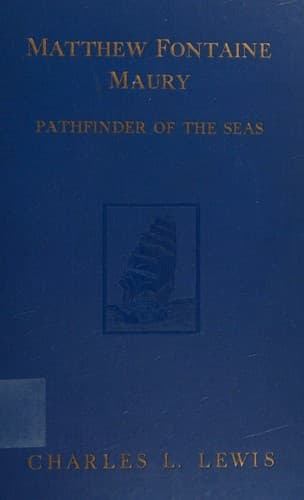
Matthew Fontaine Maury, the Pathfinder of the SeasLewis, Charles Lee
History
Matthew Fontaine Maury, the Pathfinder of the Seas
Lewis, Charles Lee
Maury, Matthew Fontaine, 1806-1873
“He would never allow us to read works of fiction whilst we were
students, and would punish most severely any departure from the truth,
or act of disobedience. These two sins, he said, were the only ones
he intended to punish his children for; and he was very careful not
to make unnecessary issues with them, and never to give an order
unless he saw that it was obeyed and not forgotten. A punishment which
he inflicted once on Betty and myself I shall never forget. Betty
borrowed ‘Helen’, one of a very handsome and complete set of Miss
Edgeworth’s novels, from cousin Sally Fontaine in Washington, thinking,
or persuading herself, that Papa would not object, as that was so mild
a type of fiction, and we both read most of it. He found us at it one
Saturday. He didn’t say one word, but took the book, and one of us in
each hand, marched us downstairs into Mamma’s room, and, to our horror,
thrust the handsome borrowed book into the flames, and held it there
with the tongs until it was entirely consumed. Oh, how we did cry! It
seemed such a terrible thing to burn a book—a priceless book—of which
we had so few. Then our honor was touched to the quick, for we had
borrowed it. But for those very reasons the lesson cut deep, and made
the impression that was intended. I for one would gladly have taken a
whipping instead, to be allowed to return the book uninjured”.[13]
Whatever sternness Maury displayed toward his children, it was so
tempered with gentleness and loving consideration that it did not
detract at all from the ideal relationship existing between them.
When his two oldest daughters were married and left their father’s
home, he saw to it that the loving ties which bound them to the rest
of the family were kept as strong as ever; and the letters which he
wrote to them were filled with the tenderest and sincerest expressions
of affection and the most tactfully worded counsel and advice. For
example, he wrote to one of them, “That you are both poor is no
ground of solicitude; happiness is above riches, and if you are not
happy, being poor, wealth would not, I apprehend, make you happy.
Poverty has its virtues, and my struggles with it are full of pleasant
remembrances. I hope your experience will tally with mine. I do not
say, strive to be content, for in that there is no progression; but be
content to strive”. At another time he wrote, “I am writing you a very
disjointed letter, my love, but I have been thinking so much of you,
and missing you so sorely, and loving you so tenderly, since you went
away, and my heart was so full, and my head so empty, that I hardly
know what I have said. Did you plant the yellow jasmine at Farleyvale?
’Tis the grand scion of the one I courted your Mother under, and I
wish it, or a slip from it, to be planted over my grave”. This request
was carried out, and the flower grew over his grave for six or seven
years until it was killed during an extremely cold winter. The entire
Public-domain text, read in full here on John Shaqi.
Reviews
Reviews
No reviews yet
Be the first to share your thoughts on this work.
Elsewhere in the archive
Join the Discussion
Join the discussion
Sign in to leave a comment or review.
Sign InorCreate an account