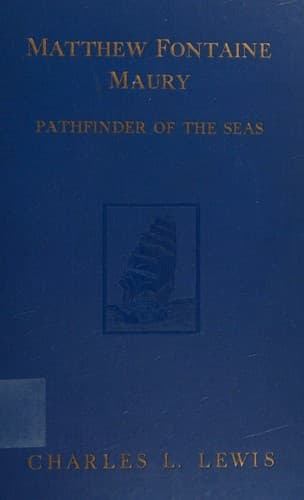
Matthew Fontaine Maury, the Pathfinder of the SeasLewis, Charles Lee
History
Matthew Fontaine Maury, the Pathfinder of the Seas
Lewis, Charles Lee
Maury, Matthew Fontaine, 1806-1873
story of Maury’s home life seems almost too nearly perfect to be true,
but diligent search of all available records has failed to disclose
anything which would detract from the portrayal of him as always the
true, considerate, loving husband and father.
[Illustration:
_Courtesy of Mrs. Thomas Fell and Mrs. C. Alphonso Smith._
MATTHEW FONTAINE MAURY AND RAPHAEL SEMMES
From a photograph made in London during the War between the States.]
[Illustration:
_Courtesy of Mrs. Thomas Fell and Mrs. C. Alphonso Smith._
MATTHEW FONTAINE MAURY AND THE REVEREND DOCTOR TREMLETT
From a photograph made in Cambridge, England, in 1868, when
Cambridge conferred the LL.D. on Maury.]
CHAPTER XI
HIS PART IN THE CIVIL WAR: IN VIRGINIA
Maury resigned from the naval service and left the National Observatory
on April 20, 1861. He declared that he worked as hard and as faithfully
for Uncle Sam up to three o’clock of that day as he had ever done, and
at that hour turned over all the public property and records of the
office to Lieutenant Whiting, the officer who was next in authority.
He left the Observatory with the deepest regret. “Its associations”,
he wrote, “the treasures there, which, with your help and that of
thousands of other friendly hands, had been collected from the sea,
were precious to me and as I turned my back upon the place a tear
furrowed my cheek, for I could not but recollect that such things were”.
From Richmond, on April 26th, he wrote to Secretary of the Navy, Gideon
Welles, who had requested to know his reasons for his resignation,
the following reply: “I am not aware of any law or rule that requires
an officer tendering resignation to give reasons therefor. In this
case, however, I have no objections to state them. They are these: our
once glorious Union is gone; the state through which and for which I
confessed allegiance to the Federal government has no longer any lot
or part in it. Neither have I. I desire to go with my own people and
with them to share the fortunes of our own state together. Such are
the reasons for tendering my resignation, and I hope the President
will consider them satisfactory”. Maury afterwards stated in detail
the reasons for his resignation in his “A Vindication of Virginia and
the South”, which was the last thing that he prepared for the press,
in May, 1871. This statement, which must be read as a whole in order
to get the full force of his arguments, is much too long to quote
here; but it is sufficient to say that his action was prompted by the
same feelings and motives that inspired Lee and the dozens of other
officers in both army and navy who went with their respective states
when secession was decided upon. Furthermore, as will be seen later, in
Maury’s case the sacrifices involved were perhaps greater than those
suffered by any other man who cast his lot with the South.
Public-domain text, read in full here on John Shaqi.
Reviews
Reviews
No reviews yet
Be the first to share your thoughts on this work.
Elsewhere in the archive
Join the Discussion
Join the discussion
Sign in to leave a comment or review.
Sign InorCreate an account