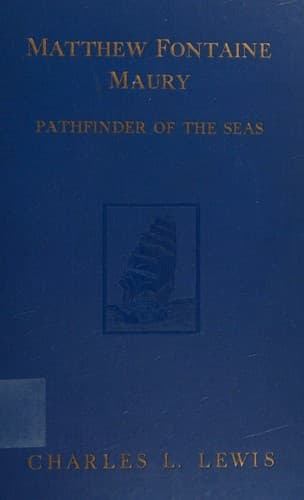
Matthew Fontaine Maury, the Pathfinder of the SeasLewis, Charles Lee
History
Matthew Fontaine Maury, the Pathfinder of the Seas
Lewis, Charles Lee
Maury, Matthew Fontaine, 1806-1873
whole secret to your keeping and discretion. Having thus placed myself
in your hands, let us make this agreement binding also upon our heirs
and assigns, and to this end I propose that the necessary steps be at
once taken. Yours truly, M. F. Maury, Confederate Navy. To Nath. J.
Holmes, Esq.”
Maury had at this time fully decided to return to the Confederate
States in the spring, and was then arranging his affairs in England
with that end in view. He hoped to arrive there early enough to make
use of his electric mines in the land warfare of the spring campaign.
He had recently undergone a surgical operation, and his friends in
England were very much opposed to his going home, some of them being
of the opinion that by the time he arrived Richmond would have been
abandoned and he would have no home to go to. But he conceived it to be
his duty to return, as he might be of greater service there than he was
abroad.
Before the date he had set for sailing, May 2, Lee had surrendered
at Appomattox and Lincoln had been assassinated; still Maury did not
change his plans, but sailed on the Royal Mail Steamer _Atrato_ with a
quantity of insulated wire, copper tanks, magnetic exploders, etc. for
Havana with the hope of being able to keep open Galveston or some other
port on the coast of Texas.
He had worried a great deal about the members of his family who were in
the Confederate service. “My dreams”, he wrote in January, 1863, “are
nightly of death and mutilation of children and friends”. Just four
days after this date his son John, who was at Vicksburg on the staff of
General Dabney H. Maury, disappeared while reconnoitering the enemy
alone, and was never heard of again.[19] News of this unfortunate event
did not reach the father until April 8, 1863, and soon afterwards he
wrote as follows on the evils of war: “War is a great scourge, and this
has touched you and me and many a good fellow with a heavy hand. As I
look out upon the landscape that lies before my window, and see the
men and women working in the fields, and the fields smiling to man’s
husbandry, when I see no marks of the spoiler, and recognize that each
one is safe in his person and secure in his possessions, then it is
I see peace, and think of my poor country with a sigh, and, oh, with
what reflections. ‘Thoughts on thoughts a countless throng’, bless
your hearts—you and John—for comforting, with so much solicitude and
affection, my poor dear wife in her affliction! Good brothers are you
both. How lovely and beautiful are the memories of my Johnny! I wonder
if all parents think of their dead as I do of mine. Bless that sleeping
boy! Never did he, in his whole life, do one single act that either
displeased or grieved me or his mother. ‘He never offended’. What an
epitaph; and how proudly I write it! But where is the end of this war
to find us—where you and yours, me and mine, and where so many that
are dear and near to us? Our charming circle of relations is, I fear,
Public-domain text, read in full here on John Shaqi.
Reviews
Reviews
No reviews yet
Be the first to share your thoughts on this work.
Elsewhere in the archive
Join the Discussion
Join the discussion
Sign in to leave a comment or review.
Sign InorCreate an account