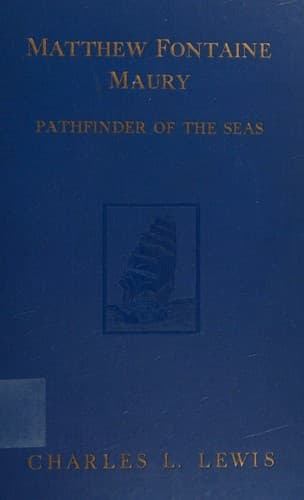
Matthew Fontaine Maury, the Pathfinder of the SeasLewis, Charles Lee
History
Matthew Fontaine Maury, the Pathfinder of the Seas
Lewis, Charles Lee
Maury, Matthew Fontaine, 1806-1873
broken up, never, never to be restored on this side of the grave”.
His family had been made refugees three different times, and Maury had
been much concerned over their needs and probable sufferings. He wrote
in the summer of 1864 to Dr. Tremlett from the Duke of Buckingham’s
palace at Stow, “I had a letter to-day of May 7th from my daughter
Nannie, and she says, ‘Flour has gone to $100 per barrel—too high for
us—but meal is cheaper, thank God!’... ‘We had for dinner to-day soup
made out of nothing, and afterwards a shin. ’Twas good, I tell you; we
all dote on shins’. And again, from my little Lucy, ‘Ham and mashed
potatoes to-day for dinner; and, as it was my birthday (9th May), Mamma
said I might eat as much as I wanted’. Here, you see, there is no
complaining, but only a gentle lifting of the curtain, which in their
devotion and solicitude they have kept so closely drawn before me. With
this pitiful picture in my mind’s eye, I felt as if I must choke with
the sumptuous viands set before me on the Duke’s table. Alas, my little
innocents!”
So it was with a heavy heart and the future all dark that he and his
young son set sail, after an absence of more than two years, for
home,—the home which Maury himself was not to see until several more
years of exile had been spent in foreign lands.
CHAPTER XIII
WITH MAXIMILIAN IN MEXICO
When Maury reached St. Thomas in the West Indies, about the middle of
May, 1865, he learned from the newspapers that the Confederacy had
completely collapsed, but he continued his voyage to Havana. From here
his son Matthew, Jr. was sent on home to Virginia; while Maury himself
waited to consider what was best for him to do—an old man now broken
in health and ruined in finances, separated from family and friends,
and without home or country.
Though he had saved practically nothing from the wreck of his financial
fortunes, caused by the war, yet his sterling honesty would not permit
him to sell the torpedo material and appropriate the money, to which
he then had as good a right as any other individual. His conduct of
the affairs of the Confederacy in England had been marked with this
same scrupulous honesty, in the expenditure of nearly $400,000. Before
leaving that country, all the vouchers for that sum were turned over
to Bulloch, correct to a figure, as attested by the following letter:
“Neither can I close this, perhaps my last letter on business matters,
without observing that although the custom here would have sanctioned
your receiving a large _per centum_ in the way of commission on
contracts, purchases, and disbursements made by me, yet you constantly
set your face against it and never to my certain knowledge received one
shilling”.
Public-domain text, read in full here on John Shaqi.
Reviews
Reviews
No reviews yet
Be the first to share your thoughts on this work.
Elsewhere in the archive
Join the Discussion
Join the discussion
Sign in to leave a comment or review.
Sign InorCreate an account