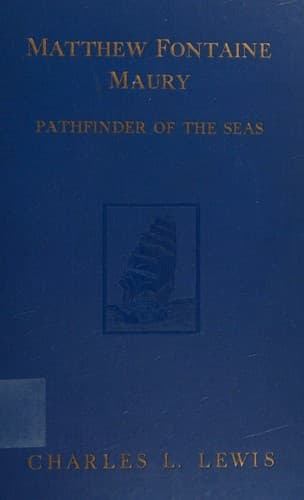
Matthew Fontaine Maury, the Pathfinder of the SeasLewis, Charles Lee
History
Matthew Fontaine Maury, the Pathfinder of the Seas
Lewis, Charles Lee
Maury, Matthew Fontaine, 1806-1873
Maury came out of the war, with no money but with a clear conscience.
“I left”, he wrote his wife, “$30,000 or $40,000 worth of torpedoes,
telegraphic wire, etc. which I bought for the defense of Richmond.
Bulloch paid for them but they were left in Havana at the breakup,
subject to my orders. I write by this mail directing that they be
turned over to Bulloch. Now they don’t belong to him, neither do they
to me. But it is quite a relief to get rid of them by transferring them
to a man who I am sure will make the most proper use of them. I did not
want any of the $10,000 or $20,000 which they will bring, though some
one will get it who has no more right to it than I have”.
[Illustration:
MAURY HALL, UNITED STATES NAVAL ACADEMY, NAMED IN HONOR OF MAURY]
Now that Virginia had laid down her arms, Maury thought it proper
to write a formal surrender of his sword. He accordingly sent the
following letter to the officer in command of the United States naval
forces in the Gulf of Mexico: “In peace as in war I follow the fortunes
of my native old state (Virginia). I read in the public prints that she
has practically confessed defeat and laid down her arms. In that act
mine were grounded also. I am here without command, officially alone,
and am bound on matters of private concern abroad. Nevertheless, and
as I consider further resistance worse than useless, I deem it proper
formally so to confess, and to pledge you in the words of honor that,
should I find myself before the final inauguration of peace within
the jurisdiction of the United States, to consider myself a prisoner
of war, bound by the terms and conditions which have been or may be
granted to General Lee and his officers. Be pleased to send your
answer through my son (Colonel R. L. Maury), a prisoner of war on
parole in Richmond. In the meantime, and until I hear to the contrary,
I shall act as though my surrender had been formally accepted on the
above-named terms and conditions”.
The status of Confederate agents abroad, at the close of the war, was
a very precarious one. As Bulloch writes, “The civil as well as the
military and naval representatives of the Confederate States abroad
were excluded from ‘pardon’, under the so-called Amnesty Proclamations,
which were issued immediately after the war, and none of them could
have returned to the United States without the certainty of arrest,
imprisonment, or, under the most favorable circumstances, the
alternative of taking what has not been inaptly called the ‘iron-clad
oath’”.[20]
Public-domain text, read in full here on John Shaqi.
Reviews
Reviews
No reviews yet
Be the first to share your thoughts on this work.
Elsewhere in the archive
Join the Discussion
Join the discussion
Sign in to leave a comment or review.
Sign InorCreate an account