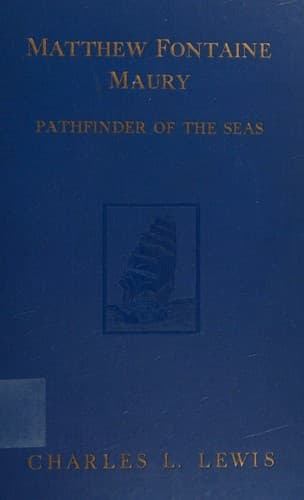
Matthew Fontaine Maury, the Pathfinder of the SeasLewis, Charles Lee
History
Matthew Fontaine Maury, the Pathfinder of the Seas
Lewis, Charles Lee
Maury, Matthew Fontaine, 1806-1873
He, accordingly, handed in his resignation in May to take effect the
following September; but there were so many protests against his
action, from the Governor of the state all down the line, that he
reconsidered the matter and agreed, in July, to remain at V. M. I.
for the time being. After his resignation, he had been approached by
a member of the Board of Trustees of the Agricultural College near
Blacksburg, Virginia, who asked permission to propose Maury’s name as
their president, but he declined the proposal. Inquiry was also made of
him whether he would accept the presidency of a Polytechnic College to
be founded at New Orleans. This appealed to him, particularly on the
score of his health, but the project did not materialize.
In addition to his work on the “Physical Survey of Virginia” and his
geographical series, Maury spent considerable time upon the preparation
and delivery of lectures and addresses, not in great numbers during
his first two years at Lexington but with increasing frequency during
the last years of his life. Among the notable speeches he made during
1869 were an address to the graduating class of V. M. I., July 2, and
another before the Educational Association of Virginia, on December
16. In the former, he emphasized the fact that what they accomplished
in life would depend largely on their own ‘resolves’, that they had
not ‘finished’ their education but merely laid the foundation, that
they should desire to master the specialty they took up but not to
become narrow-minded, and that they should form the habit of observing
nature for there they would see God. In closing, he called upon them
to live up to their traditions. The later address is a plea for the
giving of more attention in the educational system to the study of the
physical sciences in view of the progress and development of physical
discoveries; it began with the statement that the study of science
should not make atheists, if the subject was rightly interpreted.
Public-domain text, read in full here on John Shaqi.
Reviews
Reviews
No reviews yet
Be the first to share your thoughts on this work.
Elsewhere in the archive
Join the Discussion
Join the discussion
Sign in to leave a comment or review.
Sign InorCreate an account