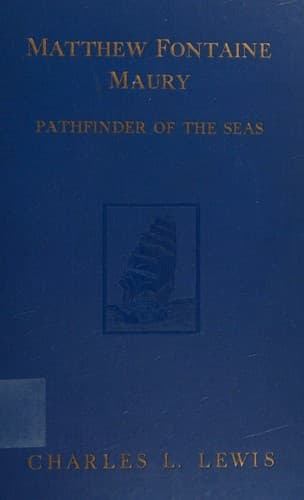
Matthew Fontaine Maury, the Pathfinder of the SeasLewis, Charles Lee
History
Matthew Fontaine Maury, the Pathfinder of the Seas
Lewis, Charles Lee
Maury, Matthew Fontaine, 1806-1873
Maury often lectured to the students of Virginia Military Institute,
though he gave no regular courses of instruction; for example, in
1872 he gave a series of lectures to the cadets on “What We Owe
to Science”. The larger number of his addresses were delivered,
however, in the interest of the establishment of a system of universal
telegraphic meteorological observations and crop reports,—the plan
which he had urged for many years before the Civil War and which
that unhappy conflict had cut short. Not long after his return to
Virginia, he began to consider this cherished plan again. “You
remember before the war”, he wrote, “how hard I tried to get up a
Telegraphic Meteorological Bureau—writing and lecturing about it—now
as meteorology for the farmers, now as storm-signals combined with
crop statistics. When I was in England, during the war, I proposed
to Fitzroy, and after his death to his successor, Toynbee, a plan
for making, by means of an elastic cloth stretched over his map, a
caste of the atmosphere, so that he might take in his whole field of
observation at a single glance, and so predict with more certainty.
Suppose, for instance, with his map pasted on a table, he had bored
a hole through London, Liverpool, Portsmouth, etc., and stuck up in
each place a little rod graduated for the barometer; that his elastic
cloth was then fitted to a slide so that he could set it at the
height of the barometer at each of the stations. Fancy each rod to be
surmounted by a wind-vane which could be drawn out or shoved in, to
show the force of the wind at each place. Thus you would have a ‘caste
of the atmosphere’, and see all about it. Brooke—‘deep-sea lead’—has
suggested just such a plan to Myer (General Albert James Myer of the
Signal Bureau in Washington); and Myer, I have heard, has adopted it.
The idea, I think, was as original with Brooke as it was with me”.
Public-domain text, read in full here on John Shaqi.
Reviews
Reviews
No reviews yet
Be the first to share your thoughts on this work.
Elsewhere in the archive
Join the Discussion
Join the discussion
Sign in to leave a comment or review.
Sign InorCreate an account