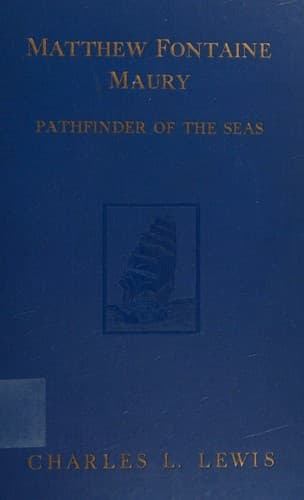
Matthew Fontaine Maury, the Pathfinder of the Seas — John Shaqi
Matthew Fontaine Maury, the Pathfinder of the SeasLewis, Charles Lee
History
Matthew Fontaine Maury, the Pathfinder of the Seas
Lewis, Charles Lee
Maury, Matthew Fontaine, 1806-1873
For an account of Maury’s experiences on this cruise little is to
be derived from his extant letters, but fortunately Chaplain C. S.
Stewart wrote a book entitled “A Visit to the South Seas in the U. S.
Ship Vincennes during the years 1829 and 1830”, in which he mentions
Maury as a member of the shore party which visited the Valley of Taioa
and as one of those who went on various other expeditions on the
island of Nukahiva under the direction of the chaplain. That these
were unforgettable experiences is evident from Stewart’s rapturous
descriptions of the people and the scenery of the island which, he
declared, “seemed almost a fairy land, scarce less fascinating in its
features than the imaginary haunts pictured by the pens of genius as
the abode of Calypso, or the happy valley of the Abyssinian prince”.
Before leaving this island Maury had an experience of peculiar
interest. It was here that his brother John had spent two years
practically cut off from civilization. Just before the War of 1812,
he had secured a furlough from the navy and had gone as first officer
in a merchantman on a voyage to China. On departing from Nukahiva,
the captain of this ship left John Maury and six men on the island
to procure sandalwood and other articles of commerce. They were, of
course, to be taken off on the return from China; but the war broke out
and the ship was blockaded in a Chinese port by the English. Meanwhile
the Americans were left to shift for themselves on Nukahiva, and in
a war between two tribes, one of which was friendly to them, all the
white men were killed except John Maury and another man named Baker.
Fortunately, Porter visited the island during the famous cruise of
the _Essex_, and rescued the two survivors. In order that he might
learn something about the history of his brother while on the island,
Midshipman Maury set about studying the language of the natives, during
the three weeks or so of his visit. And shortly before his departure
he was able to converse with the old chief who had been his brother’s
friend. “The Happas and the Typees”, Maury wrote, “were at war. The
latter having just captured three children from the former, we went
to the rescue and recovered two, the third had been eaten. When we
returned to the Happa Valley from the expedition—it was the valley
where dwelt my brother—the men had liberty and the old Happa chief
remained on board as a hostage, for his subjects were all a set of
savages and the women literally in the fig leaf state. At night when
all the men had come off safe and sound, and a few days only before we
left, I was sent to take the old fellow ashore. Going ashore, I made
myself known to him. He was the firm and fast friend of my brother. Had
saved his life. He was then old. He it was that offered me his scepter,
his own wife, and the daughter of a neighboring chief if I would
remain”.
Public-domain text, read in full here on John Shaqi.
Reviews
Reviews
No reviews yet
Be the first to share your thoughts on this work.
Join the Discussion
Join the discussion
Sign in to leave a comment or review.
Sign InorCreate an account