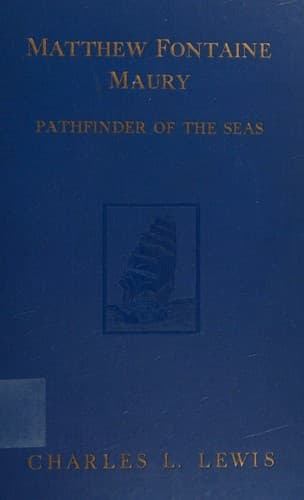
Matthew Fontaine Maury, the Pathfinder of the SeasLewis, Charles Lee
History
Matthew Fontaine Maury, the Pathfinder of the Seas
Lewis, Charles Lee
Maury, Matthew Fontaine, 1806-1873
With some leisure at his command, Maury determined to become an author,
under the encouragement of the recent appearance in the _American
Journal of Science and Arts_ of his first scientific article, “On the
Navigation of Cape Horn”. This, the first fruit of his sea experience,
described forcefully the dangers of the passage of Cape Horn, and gave
specific information concerning the winds and the peculiar rising and
falling of the barometer in those latitudes. In the same number of
this journal there appeared another article describing Maury’s “Plan
of an Instrument for Finding the True Lunar Distance”, the instrument
in question having been invented by him. With these beginnings, he
ambitiously set to work to finish a book on navigation, which he had
commenced during the last part of his recent tour of sea duty. He did
not expect to receive much direct profit from such a nautical book,
but hoped that it might be of a collateral advantage to him in making
his name known to the Navy Department and to his brother officers. As
it was the first nautical work of science ever to come from the pen of
an American naval officer, he expected to base a claim for promotion
on the merits of the book, and had hopes of being made a lieutenant of
ten years’ rank with the accompanying back pay amounting to $4,000 or
$5,000.
[Illustration:
_Courtesy of “The Journal of American History,” Vol. IV, Number 3
(1910)._
LIEUT. M. F. MAURY
From a daguerreotype of about the year 1855]
These plans of Maury’s did not fully materialize. President Jackson
was of the opinion that the young author deserved promotion for his
scientific work and reimbursement for the money which he had expended
in its publication, but the Secretary of the Navy, Mahlon Dickerson,
did not carry out the President’s wishes. The book itself, however,
was a great success on its appearance early in the year 1836, under
the title of “A New Theoretical and Practical Treatise on Navigation”.
The publishers, E. C. and J. Biddle of Philadelphia, soon had the
pleasure of printing a long list of favorable opinions of the work
from professors and distinguished officers in the navy, among which
the commendation of Nathaniel Bowditch gave Maury the greatest
satisfaction. His book very quickly took the place of Bowditch’s
“Practical Navigator” as a textbook for junior officers in the navy,
and when the Naval Academy was established at Annapolis it was used
for several years as the basis of the instruction given to midshipmen
in navigation. In the title page appeared the significant words, “Cur
Non?” (Why not?), the motto adopted by Lafayette when he espoused the
cause of the American colonies; this was in effect Maury’s answer to
any query that might be made as to why a young naval officer should
attempt the writing of a book.
Public-domain text, read in full here on John Shaqi.
Reviews
Reviews
No reviews yet
Be the first to share your thoughts on this work.
Join the Discussion
Join the discussion
Sign in to leave a comment or review.
Sign InorCreate an account