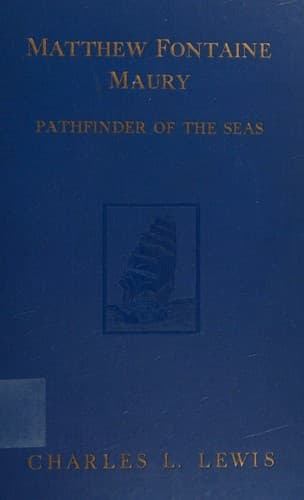
Matthew Fontaine Maury, the Pathfinder of the SeasLewis, Charles Lee
History
Matthew Fontaine Maury, the Pathfinder of the Seas
Lewis, Charles Lee
Maury, Matthew Fontaine, 1806-1873
It was a well-chosen and apt title, which enabled Maury to treat in
the same article of various matters more or less unrelated. Among the
various topics that he touched upon was, first, the desirability of
having grades in the navy higher than those of captain, to correspond
with those in foreign navies. He also declared that there should be
a larger force on the coast of Africa to put down the traffic in
slaves, and more warships in the Pacific to support American commerce
with China and to protect American fishermen on the whaling grounds.
Thus prophetically did he portray the future of American trade on
that ocean: “If you have a map of the world at hand, turn to it and,
placing your finger at the mouth of the Columbia River, consider its
geographical position and the commercial advantages which, at some day
not far distant, that point will possess. To the south, in one unbroken
line, lie several thousand miles of coast indented with rich markets
of Spanish America—to the west, Asiatic Russia and China are close at
hand—between the south and west are New Holland and Polynesia; and
within good marketable distance are all the groups and clusters of
islands that stud the ocean, from Cape Horn to the Cape of Good Hope,
from Asia to America. Picture to yourself civilization striding the
Rocky Mountains, and smiling down upon the vast and fruitful regions
beyond, and calculate, if you can, the important and future greatness
of that point to a commercial and enterprising people. Yet the first
line in the hydrography of such a point remains to be run. It has been
more than twenty years since an American man-of-war so much as looked
into the mouth of the Columbia River. Upon what more important service
could a small force be dispatched than to survey and bring home correct
charts of that river and its vicinity?”
He then pointed out the unpreparedness of the country for war, and
dwelt upon how the United States was forced weakly to acquiesce in the
blockading of Mexico and the La Plata by France, and make no protest at
the strengthening of her forts on the Great Lakes by England who was
thus violating her treaty with this government. The navy should, he
declared, experiment with steam vessels of war, and Pensacola and some
point on the coast of Georgia or the eastern coast of Florida should be
fortified. Turning then to personnel, he continued: “It takes something
more than spars and guns, and walls of wood to constitute a navy. These
are only the body—the arms and legs without the thews and sinews.
It requires the muscle of the brawny seaman, and the spirit of the
well-trained officer to impart life and motion to such a body, to give
vigor and energy to the whole system”.
Public-domain text, read in full here on John Shaqi.
Reviews
Reviews
No reviews yet
Be the first to share your thoughts on this work.
Join the Discussion
Join the discussion
Sign in to leave a comment or review.
Sign InorCreate an account