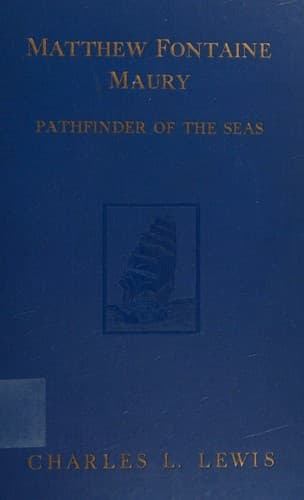
Matthew Fontaine Maury, the Pathfinder of the Seas — John Shaqi
Matthew Fontaine Maury, the Pathfinder of the SeasLewis, Charles Lee
History
Matthew Fontaine Maury, the Pathfinder of the Seas
Lewis, Charles Lee
Maury, Matthew Fontaine, 1806-1873
In November, 1841, Maury made another request for active service.
In order that his family and friends might not defeat his purpose,
he went to Richmond and from there wrote to Secretary of the Navy
George E. Badger, suggesting that he was able to perform any of the
lighter duties at sea which did not call for much bodily exercise, and
requesting that he be appointed flag-lieutenant in the Pacific Squadron
under Commodore Jones, who had signified a desire to have him in this
post. His purpose, however, was thwarted by Judge John T. Lomax, a warm
personal friend, who wrote to the Secretary and enclosed a certificate
from three of the best physicians of Fredericksburg to the effect that
Maury was in no condition for life on board ship; and as a consequence
he was retained on the list of those “waiting orders”.
After the completion of his “Scraps from the Lucky Bag”, Maury
continued to write for the _Southern Literary Messenger_; he rendered
editorial service to Mr. White, the owner of the magazine, during the
year 1842, and was virtually the editor during the first eight months
of 1843 after White’s death. He contributed also to the _Army and Navy
Chronicle_ and the _Southern Quarterly Review_ of Charleston.
His “Letters to Clay” in the _Messenger_ under the pseudonym of “Union
Jack” strongly advocated the establishment of a national dockyard at
Memphis, government subsidies for the building of steam packets as
England and France were doing, a national steamboat canal from the
upper Mississippi River to the Lakes for defense against Canada in
case of war with Great Britain, a strong naval establishment at some
place on the Atlantic seaboard south of Norfolk, and the making of
Pensacola a veritable “Toulon on the Mediterranean”. The following
year, 1842, he took up in the same journal the question of the right of
Great Britain to visit and search American ships in the “suspicious”
latitudes off Africa in the endeavor to suppress the slave trade. He
was against according this right to England because of the temptation
to use the power involved in an arbitrary manner greatly to the injury
of American commerce, and he was of the opinion that it was merely
an attempt, under the pretext of supporting the “Christian League”
or Quintuple Alliance, to revive the old claim of England’s right to
violate sailors’ rights and the freedom of the seas, principles fought
for in the War of 1812. He referred, in passing, to the tense feeling
against Great Britain on account of the Maine Boundary dispute, and the
desire, on the part of many, even for war. “On the contrary”, he wrote,
“I should view a war between the United States and Great Britain as one
of the greatest calamities, except a scourge direct from the hand of
God, that could befall my country”. But he added, “In the navy, there
is but one sentiment and one feeling on this subject; it is, avert war,
honorably if you can; if not, let it come: right or wrong, the stars
Public-domain text, read in full here on John Shaqi.
Reviews
Reviews
No reviews yet
Be the first to share your thoughts on this work.
Join the Discussion
Join the discussion
Sign in to leave a comment or review.
Sign InorCreate an account