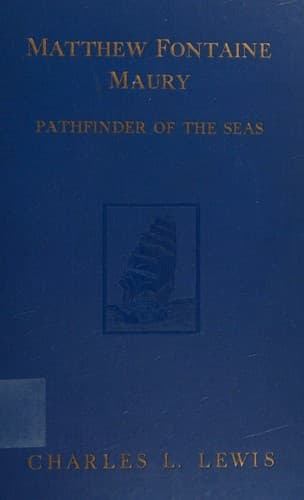
Matthew Fontaine Maury, the Pathfinder of the SeasLewis, Charles Lee
History
Matthew Fontaine Maury, the Pathfinder of the Seas
Lewis, Charles Lee
Maury, Matthew Fontaine, 1806-1873
Maury’s first volume of astronomical observations, the first indeed to
be issued from an American observatory, appeared in 1846. Though this
was pioneer work, it was important enough to cause one of the most
distinguished astronomers of Europe to conclude that it had placed
the American observatory in the front rank with the oldest and best
institutions of the kind in Europe. In the appendix to this volume,
Maury gives very generous credit and praise to his helpers, among whom
were at this time the distinguished mathematicians Hubbard, Keith, and
Coffin; but he adds that he considers himself alone responsible for
the accuracy of the work as nothing had been published until it had
passed his supervision and approval.
A very ambitious work which Maury began during the year 1845 was a
catalogue of the stars. The aim was to cover every point of space
in the visible heavens with telescopes, get the position of every
star, cluster, and nebula, and record both magnitude and color, with
the angle of position and the distance of binary stars together with
descriptions and drawings of all clusters and nebulæ. No astronomical
work on such an extensive scale had ever before been executed or even
attempted, though the value and importance of it were manifold and
difficult of full estimation. Maury wrote that it was his intention to
make a contribution to astronomy that would be worthy of the nation
and the age, and to so execute the undertaking that future astronomers
would value it so highly as to say that such a star was not visible in
the heavens at the date of the Washington Catalogue because it is not
recorded therein.
An interesting example of the extremely practical value of such a
catalogue came up in connection with Leverrier’s discovery of the
planet Neptune. In the autumn of 1846, after the discovery of this
planet, Maury ordered one of his observers to trace its path backwards
to see if some astronomer had observed it and entered it as a fixed
star. On February 1, 1847, the observer, Sears Cook Walker, gave a list
of fourteen stars from Lalande’s catalogue in his “Histoire Céleste”,
where Neptune should have been approximately in May, 1795. Professor
Hubbard was then directed by Maury to examine with the equatorial,
and he found on the night of February 4 that the suspected star was
missing. It was concluded, therefore, that Lalande had observed and
recorded Neptune as a fixed star on the nights of May 8 and 10, 1795.
This discovery enabled astronomers to compute the new planet’s orbit
from observations extending over a period of fifty years.
Public-domain text, read in full here on John Shaqi.
Reviews
Reviews
No reviews yet
Be the first to share your thoughts on this work.
Join the Discussion
Join the discussion
Sign in to leave a comment or review.
Sign InorCreate an account