He had heard the whole story at Meadow Brook, but this was the first
time he had hinted it to Ada, who turned very pale and without another
word left the room, going back to Cedar Grove, where for three weeks she
pouted and cried alternately. At the end of that time, however, she
concluded it better to “make up” so she wrote a note to us both, asking
_my_ pardon for her rudeness and begging my husband to forgive her for
the many falsehoods she had told concerning her engagement with Herbert,
which she now frankly confessed. Of course we forgave her, and as she
was not one who remembered anything long, she soon began to visit us as
of old, though she no longer sat on my husband’s knee, or wound her arms
around his neck. His rebuke did her good, and she profited by it, while
the fact that he was fully aware of the deception she had practised
tended to humble her, and on rainy days, when Richard was necessarily
away from home, I found her quite an agreeable companion.
Thus the winter and spring passed away, and my mother’s letters began to
grow urgent for my return, but for various reasons Richard did not think
it advisable for me to under take so long a journey, and as Sunny Bank
was all the world to me, I very cheerfully consented to wait until
another season ere I visited my New England home. About this time I was
again seized with my olden desire for authorship, induced in a measure
by my knowing how much Mrs. Lansing reverenced anything which savored of
a book-writer. To be an _authoress_, then, and make her proud to own me
as her sister, was a subject over which I grew pale and “nervous,”
Richard said, while the negroes called me “fidgety” and wondered “what
done ailded Miss Rose.” At last, after many wakeful nights and restless
days, after sick headaches, nervous headaches, and all kind of
headaches, the plan was marked out for a story. _I_ would be the heroine
myself and give to the world as much of my history as I thought proper,
and if I failed—if no railroad, steamboat, or stagecoach passenger ever
pointed me out as “the woman who wrote that book,” or if my publishers
“respectfully declined” another bearing my signature, I thought I should
still have the satisfaction of knowing I had tried to benefit the world,
and I felt almost sure that in Meadow Brook at least there were people
stupid enough to buy my book and possibly to like it, just because
little Rosa Lee, who used to climb fences and hunt hen’s eggs with them
in her childish days, had written it. So, one sunny morning in June,
when my husband had left me to be gone for two weeks, I shut myself up
in my room, donned a loose wrapper, tucked back my curls, opened my
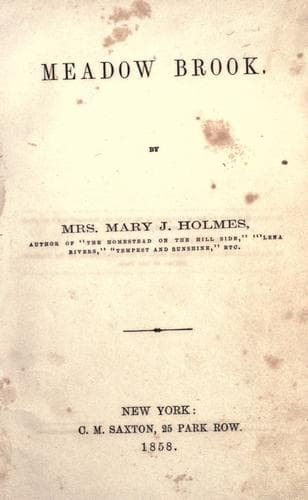
writing desk, took out a quire of foolscap, and had just written “MEADOW
BROOK,” when the bell rang and Bertha announced “a lady in the parlor.”
With a deep sigh, as I thought how “WE writers disliked to be
disturbed,” I arranged my curls, resumed my cambric morning gown, and
Public-domain text, read in full here on John Shaqi.
Reviews
Reviews
No reviews yet
Be the first to share your thoughts on this work.
Elsewhere in the archive
Join the Discussion
Join the discussion
Sign in to leave a comment or review.
Sign InorCreate an account