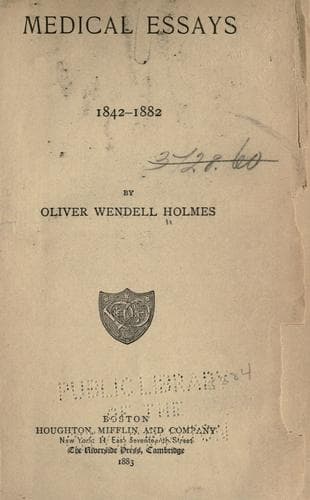
Education, Medical -- Massachusetts -- 19th century; Homeopathy; Libraries, Medical -- Massachusetts -- 19th century; Medicine
Then will come the usual talk about a change in the character
of disease, which has about as much meaning as that concerning
“old-fashioned snow-storms.” “Epidemic constitutions” of disease mean
something, no doubt; a great deal as applied to malarious affections;
but that the whole type of diseases undergoes such changes that the
practice must be reversed from depleting to stimulating, and vice versa,
is much less likely than that methods of treatment go out of fashion and
come in again. If there is any disease which claims its percentage with
reasonable uniformity, it is phthisis. Yet I remember that the reverend
and venerable Dr. Prince of Salem told me one Commencement day, as I was
jogging along towards Cambridge with him, that he recollected the time
when that disease was hardly known; and in confirmation of his
statement mentioned a case in which it was told as a great event, that
somebody down on “the Cape” had died of “a consumption.” This story does
not sound probable to myself, as I repeat it, yet I assure you it is
true, and it shows how cautiously we must receive all popular stories of
great changes in the habits of disease.
Is there no progress, then, but do we return to the same beliefs and
practices which our forefathers wore out and threw away? I trust and
believe that there is a real progress. We may, for instance, return in
a measure to the Brunonian stimulating system, but it must be in a
modified way, for we cannot go back to the simple Brunonian pathology,
since we have learned too much of diseased action to accept its
convenient dualism. So of other doctrines, each new Avatar strips them
of some of their old pretensions, until they take their fitting place
at last, if they have any truth in them, or disappear, if they were mere
phantasms of the imagination.
In the mean time, while medical theories are coming in and going out,
there is a set of sensible men who are never run away with by them, but
practise their art sagaciously and faithfully in much the same way from
generation to generation. From the time of Hippocrates to that of our
own medical patriarch, there has been an apostolic succession of wise
and good practitioners. If you will look at the first aphorism of the
ancient Master you will see that before all remedies he places the
proper conduct of the patient and his attendants, and the fit ordering
of all the conditions surrounding him. The class of practitioners I have
referred to have always been the most faithful in attending to these
points. No doubt they have sometimes prescribed unwisely, in compliance
with the prejudices of their time, but they have grown wiser as they
have grown older, and learned to trust more in nature and less in their
plans of interference. I believe common opinion confirms Sir James
Clark's observation to this effect.
Public-domain text, read in full here on John Shaqi.
Reviews
Reviews
No reviews yet
Be the first to share your thoughts on this work.
Elsewhere in the archive
Join the Discussion
Join the discussion
Sign in to leave a comment or review.
Sign InorCreate an account