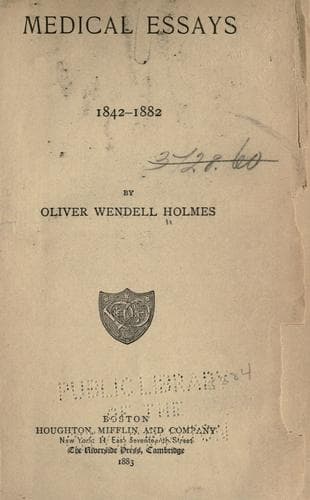
Education, Medical -- Massachusetts -- 19th century; Homeopathy; Libraries, Medical -- Massachusetts -- 19th century; Medicine
I have been in relation successively with the English and American
evacuant and alterative practice, in which calomel and antimony figured
so largely that, as you may see in Dr. Jackson's last “Letter,” Dr.
Holyoke, a good representative of sterling old-fashioned medical art,
counted them with opium and Peruvian bark as his chief remedies; with
the moderately expectant practice of Louis; the blood-letting “coup
sur coup” of Bouillaud; the contra-stimulant method of Rasori and his
followers; the anti-irritant system of Broussais, with its leeching
and gum-water; I have heard from our own students of the simple opium
practice of the renowned German teacher, Oppolzer; and now I find the
medical community brought round by the revolving cycle of opinion to
that same old plan of treatment which John Brown taught in Edinburgh
in the last quarter of the last century, and Miner and Tully fiercely
advocated among ourselves in the early years of the present. The
worthy physicians last mentioned, and their antagonist Dr. Gallup, used
stronger language than we of these degenerate days permit ourselves.
“The lancet is a weapon which annually slays more than the sword,” says
Dr. Tully. “It is probable that, for forty years past, opium and
its preparations have done seven times the injury they have rendered
benefit, on the great scale of the world,” says Dr. Gallup.
What is the meaning of these perpetual changes and conflicts of medical
opinion and practice, from an early antiquity to our own time? Simply
this: all “methods” of treatment end in disappointment of those
extravagant expectations which men are wont to entertain of medical art.
The bills of mortality are more obviously affected by drainage, than by
this or that method of practice. The insurance companies do not commonly
charge a different percentage on the lives of the patients of this or
that physician. In the course of a generation, more or less, physicians
themselves are liable to get tired of a practice which has so little
effect upon the average movement of vital decomposition. Then they are
ready for a change, even if it were back again to a method which has
already been tried, and found wanting.
Our practitioners, or many of them, have got back to the ways of old Dr.
Samuel Danforth, who, as it is well known, had strong objections to
the use of the lancet. By and by a new reputation will be made by some
discontented practitioner, who, tired of seeing patients die with their
skins full of whiskey and their brains muddy with opium, returns to a
bold antiphlogistic treatment, and has the luck to see a few patients
of note get well under it. So of the remedies which have gone out of
fashion and been superseded by others. It can hardly be doubted that
they will come into vogue again, more or less extensively, under the
influence of that irresistible demand for change just referred to.
Public-domain text, read in full here on John Shaqi.
Reviews
Reviews
No reviews yet
Be the first to share your thoughts on this work.
Elsewhere in the archive
Join the Discussion
Join the discussion
Sign in to leave a comment or review.
Sign InorCreate an account