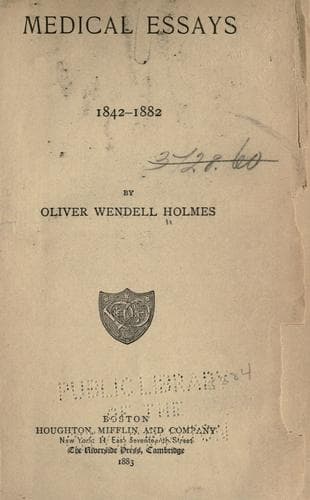
Education, Medical -- Massachusetts -- 19th century; Homeopathy; Libraries, Medical -- Massachusetts -- 19th century; Medicine
I hope we are not all wrong. Oftentimes in finding how sadly ignorant
of really essential and vital facts and rules were some of those whom
we had been larding with the choicest scraps of science, I have doubted
whether the old one-man system of teaching, when the one man was of the
right sort, did not turn out better working physicians than our more
elaborate method. The best practitioner I ever knew was mainly shaped
to excellence in that way. I can understand perfectly the regrets of my
friend Dr. John Brown of Edinburgh, for the good that was lost with the
old apprenticeship system. I understand as well Dr. Latham's fear “that
many men of the best abilities and good education will be deterred from
prosecuting physic as a profession, in consequence of the necessity
indiscriminately laid upon all for impossible attainments.”
I feel therefore impelled to say a very few words in defence of
that system of teaching adopted in our Colleges, by which we wish to
supplement and complete the instruction given by private individuals or
by what are often called Summer Schools.
The reason why we teach so much that is not practical and in itself
useful, is because we find that the easiest way of teaching what is
practical and useful. If we could in any way eliminate all that would
help a man to deal successfully with disease, and teach it by itself
so that it should be as tenaciously rooted in the memory, as easily
summoned when wanted, as fertile in suggestion of related facts, as
satisfactory to the peremptory demands of the intelligence as if taught
in its scientific connections, I think it would be our duty so to teach
the momentous truths of medicine, and to regard all useless additions as
an intrusion on the time which should be otherwise occupied.
But we cannot successfully eliminate and teach by itself that which is
purely practical. The easiest and surest way of acquiring facts is to
learn them in groups, in systems, and systematized knowledge is science.
You can very often carry two facts fastened together more easily than
one by itself, as a housemaid can carry two pails of water with a hoop
more easily than one without it. You can remember a man's face, made
up of many features, better than you can his nose or his mouth or his
eye-brow. Scores of proverbs show you that you can remember two lines
that rhyme better than one without the jingle. The ancients, who knew
the laws of memory, grouped the seven cities that contended for the
honor of being Homer's birthplace in a line thus given by Aulus Gellius:
Smurna, Rodos, Colophon, Salamin, Ios, Argos, Athenai.
Public-domain text, read in full here on John Shaqi.
Reviews
Reviews
No reviews yet
Be the first to share your thoughts on this work.
Elsewhere in the archive
Join the Discussion
Join the discussion
Sign in to leave a comment or review.
Sign InorCreate an account