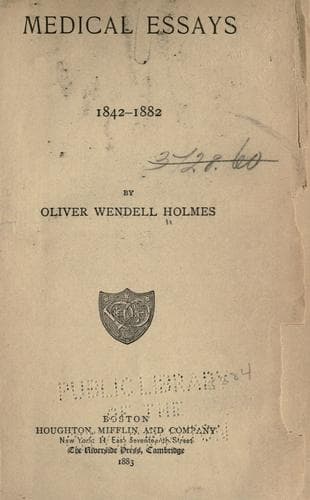
Education, Medical -- Massachusetts -- 19th century; Homeopathy; Libraries, Medical -- Massachusetts -- 19th century; Medicine
Medicine, sometimes impertinently, often ignorantly, often carelessly
called “allopathy,” appropriates everything from every source that can
be of the slightest use to anybody who is ailing in any way, or like to
be ailing from any cause. It learned from a monk how to use antimony,
from a Jesuit how to cure agues, from a friar how to cut for stone, from
a soldier how to treat gout, from a sailor how to keep off scurvy, from
a postmaster how to sound the Eustachian tube, from a dairy-maid how
to prevent small-pox, and from an old market-woman how to catch the
itch-insect. It borrowed acupuncture and the moxa from the Japanese
heathen, and was taught the use of lobelia by the American savage.
It stands ready to-day to accept anything from any theorist, from any
empiric who can make out a good case for his discovery or his remedy.
“Science” is one of its benefactors, but only one, out of many. Ask the
wisest practising physician you know, what branches of science help
him habitually, and what amount of knowledge relating to each branch he
requires for his professional duties. He will tell you that scientific
training has a value independent of all the special knowledge acquired.
He will tell you that many facts are explained by studying them in the
wider range of related facts to which they belong. He will gratefully
recognize that the anatomist has furnished him with indispensable data,
that the physiologist has sometimes put him on the track of new modes
of treatment, that the chemist has isolated the active principles of
his medicines, has taught him how to combine them, has from time to time
offered him new remedial agencies, and so of others of his allies. But
he will also tell you, if I am not mistaken, that his own branch of
knowledge is so extensive and so perplexing that he must accept most
of his facts ready made at their hands. He will own to you that in the
struggle for life which goes on day and night in our thoughts as in the
outside world of nature, much that he learned under the name of science
has died out, and that simple homely experience has largely taken the
place of that scholastic knowledge to which he and perhaps some of his
instructors once attached a paramount importance.
Public-domain text, read in full here on John Shaqi.
Reviews
Reviews
No reviews yet
Be the first to share your thoughts on this work.
Elsewhere in the archive
Join the Discussion
Join the discussion
Sign in to leave a comment or review.
Sign InorCreate an account