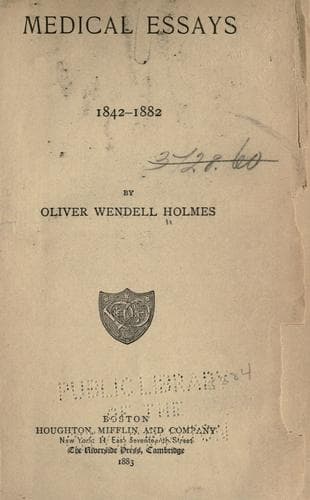
Education, Medical -- Massachusetts -- 19th century; Homeopathy; Libraries, Medical -- Massachusetts -- 19th century; Medicine
The commonest mode of misrepresentation was this: qualified
propositions, the whole meaning of which depended on the qualifications,
were stripped of these and taken as absolute. Thus, the attempt to
establish a presumption against giving poisons to sick persons was
considered as equivalent to condemning the use of these substances.
The only important inference the writer has been able to draw from the
greater number of the refutations of his opinions which have been kindly
sent him, is that the preliminary education of the Medical Profession is
not always what it ought to be.
One concession he is willing to make, whatever sacrifice of pride it
may involve. The story of Massasoit, which has furnished a coral, as it
were, for some teething critics, when subjected to a powerful logical
analysis, though correct in its essentials, proves to have been told
with exceptionable breadth of statement, and therefore (to resume
the metaphor) has been slightly rounded off at its edges, so as to
be smoother for any who may wish to bite upon it hereafter. In
other respects the Discourse has hardly been touched. It is only an
individual's expression, in his own way, of opinions entertained by
hundreds of the Medical Profession in every civilized country, and has
nothing in it which on revision the writer sees cause to retract or
modify. The superstitions it attacks lie at the very foundation of
Homoeopathy, and of almost every form of medical charlatanism. Still
the mere routinists and unthinking artisans in most callings dislike
whatever shakes the dust out of their traditions, and it may be
unreasonable to expect that Medicine will always prove an exception to
the rule. One half the opposition which the numerical system of Louis
has met with, as applied to the results of treatment, has been owing
to the fact that it showed the movements of disease to be far more
independent of the kind of practice pursued than was agreeable to the
pride of those whose self-confidence it abated.
The statement, that medicines are more sparingly used in physicians'
families than in most others, admits of a very natural explanation,
without putting a harsh construction upon it, which it was not
intended to admit. Outside pressure is less felt in the physician's own
household; that is all. If this does not sometimes influence him to give
medicine, or what seems to be medicine, when among those who have more
confidence in drugging than his own family commonly has, the learned
Professor Dunglison is hereby requested to apologize for his definition
of the word Placebo, or to expunge it from his Medical Dictionary.
Public-domain text, read in full here on John Shaqi.
Reviews
Reviews
No reviews yet
Be the first to share your thoughts on this work.
Join the Discussion
Join the discussion
Sign in to leave a comment or review.
Sign InorCreate an account