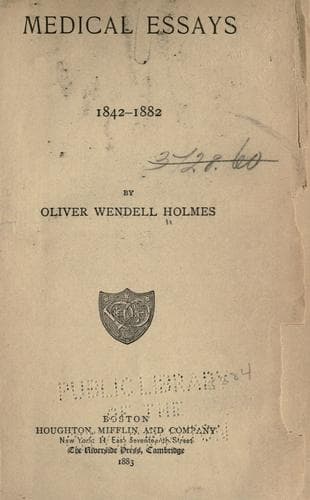
Education, Medical -- Massachusetts -- 19th century; Homeopathy; Libraries, Medical -- Massachusetts -- 19th century; Medicine
“And yet, methinks, our children are as cheerful, fat, and lusty, with
feeding upon those mussels, clams, and other fish, as they were in
England with their fill of bread.”
Higginson, himself a dyspeptic, “continually in physic,” as he says, and
accustomed to dress in thick clothing, and to comfort his stomach with
drink that was “both strong and stale,”--the “jolly good ale and old,” I
suppose, of free and easy Bishop Still's song,--found that he both could
and did oftentimes drink New England water very well,--which he seems
to look upon as a remarkable feat. He could go as lightclad as any,
too, with only a light stuff cassock upon his shirt, and stuff breeches
without linings. Two of his children were sickly: one,--little misshapen
Mary,--died on the passage, and, in her father's words, “was the first
in our ship that was buried in the bowels of the great Atlantic sea;”
the other, who had been “most lamentably handled” by disease, recovered
almost entirely “by the very wholesomeness of the air, altering,
digesting, and drying up the cold and crude humors of the body.”
Wherefore, he thinks it a wise course for all cold complexions to come
to take physic in New England, and ends with those often quoted words,
that “a sup of New England's air is better than a whole draught of Old
England's ale.” Mr. Higginson died, however, “of a hectic fever,” a
little more than a year after his arrival.
The medical records which I shall cite show that the colonists were not
exempt from the complaints of the Old World. Besides the common diseases
to which their descendants are subject, there were two others, to
say nothing of the dreaded small-pox, which later medical science has
disarmed,--little known among us at the present day, but frequent
among the first settlers. The first of these was the scurvy, already
mentioned, of which Winthrop speaks in 1630, saying, that it proved
fatal to those who fell into discontent, and lingered after their former
conditions in England; the poor homesick creatures in fact, whom we so
forget in our florid pictures of the early times of the little band in
the wilderness. Many who were suffering from scurvy got well when
the Lyon arrived from England, bringing store of juice of lemons. The
Governor speaks of another case in 1644; and it seems probable that the
disease was not of rare occurrence.
Public-domain text, read in full here on John Shaqi.
Reviews
Reviews
No reviews yet
Be the first to share your thoughts on this work.
Elsewhere in the archive
Join the Discussion
Join the discussion
Sign in to leave a comment or review.
Sign InorCreate an account