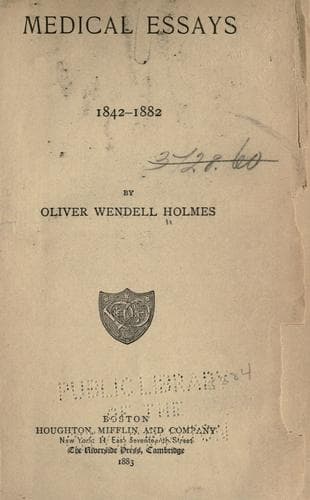
Education, Medical -- Massachusetts -- 19th century; Homeopathy; Libraries, Medical -- Massachusetts -- 19th century; Medicine
This course of argument is so often employed, that it deserves to be
expanded a little, so that its length and breadth may be fairly seen.
A series of what are called facts is brought forward to prove some very
improbable doctrine. It is objected by judicious people, or such as have
devoted themselves to analogous subjects, that these assumed facts are
in direct opposition to all that is known of the course of nature, that
the universal experience of the past affords a powerful presumption
against their truth, and that in proportion to the gravity of these
objections, should be the number and competence of the witnesses. The
answer is a ready one. What do we know of the mysteries of Nature? Do
we understand the intricate machinery of the Universe? When to this is
added the never-failing quotation,
“There are more things in heaven and earth, Horatio,
Than are dreamt of in your philosophy,”--
the question is thought to be finally disposed of.
Take the case of astrology as an example. It is in itself strange and
incredible that the relations of the heavenly bodies to each other at a
given moment of time, perhaps half a century ago, should have anything
to do with my success or misfortune in any undertaking of to-day.
But what right have I to say it cannot be so? Can I bind the sweet
influences of Pleiades, or loose the bands of Orion? I do not know by
what mighty magic the planets roll in their fluid paths, confined to
circles as unchanging as if they were rings of steel, nor why the great
wave of ocean follows in a sleepless round upon the skirts of moonlight;
nor can I say from any certain knowledge that the phases of the heavenly
bodies, or even the falling of the leaves of the forest, or the manner
in which the sands lie upon the sea-shore, may not be knit up by
invisible threads with the web of human destiny. There is a class
of minds much more ready to believe that which is at first sight
incredible, and because it is incredible, than what is generally thought
reasonable. Credo quia impossibile est,--“I believe, because it is
impossible,”--is an old paradoxical expression which might be literally
applied to this tribe of persons. And they always succeed in finding
something marvellous, to call out the exercise of their robust faith.
The old Cabalistic teachers maintained that there was not a verse,
line, word, or even letter in the Bible which had not a special efficacy
either to defend the person who rightly employed it, or to injure his
enemies; always provided the original Hebrew was made use of. In the
hands of modern Cabalists every substance, no matter how inert, acquires
wonderful medicinal virtues, provided it be used in a proper state of
purity and subdivision.
Public-domain text, read in full here on John Shaqi.
Reviews
Reviews
No reviews yet
Be the first to share your thoughts on this work.
Join the Discussion
Join the discussion
Sign in to leave a comment or review.
Sign InorCreate an account