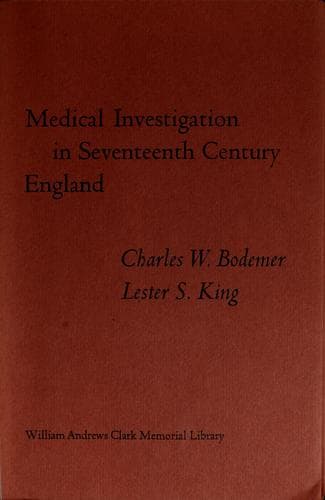
Medical investigation in seventeenth century EnglandBodemer, Charles W.
History
Medical investigation in seventeenth century England
Bodemer, Charles W.
Boyle, Robert, 1627-1691; Embryology -- England -- History -- 17th century
In no way bound by guild rules and conventions or by rigid educational
standards, Boyle was free to learn from whatever sources appealed to
him. Repeatedly he emphasized the importance of learning from
experience, both his own and that of others, and by "others" he included
not only physicians and learned gentlemen, but even the meanest of
society, provided they had experience in treating disease. This
experience need not be restricted to treatment of humans but should
include animals as well. Thus, in speaking of even the "skilfullest
physicians," he indicated that many of them "might, without
disparagement to their profession, do it an useful piece of service, if
they would be pleased to collect and digest all the approved experiments
and practices of the farriers, graziers, butchers, and the like, which
the ancients did not despise...; and ... which might serve to
illustrate the _methodus medendi_."[49] He was quite critical of
physicians who were too conservative even to examine the claims of the
nonprofessionals, especially those who were relatively low in the social
or intellectual scale. This casts an interesting sidelight on the
snobbishness of the medical profession.
Boyle's willingness and ability to ignore the restrictions of an
Establishment represent the full flowering of what I might call the
Renaissance spirit--the drive to go outside accepted bounds, to
explore, to _try_, to avoid commitment, and to investigate for oneself.
What internal and external factors permit a successful breakaway from
tradition? Rebels there have always been, yet successful rebels are
relatively infrequent. The late seventeenth century was a period of
successful rebellion, and the virtuosi were one of the factors which
contributed to the success. Robert Boyle played a significant part in
introducing new methods into science and new science into medicine.
Public-domain text, read in full here on John Shaqi.
Reviews
Reviews
No reviews yet
Be the first to share your thoughts on this work.
Join the Discussion
Join the discussion
Sign in to leave a comment or review.
Sign InorCreate an account