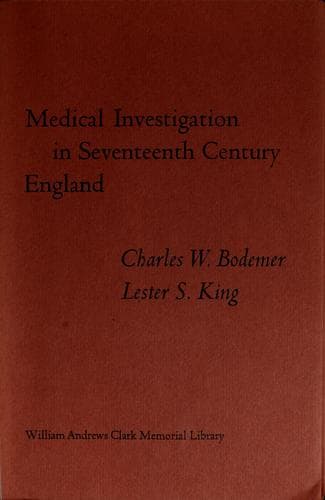
Medical investigation in seventeenth century EnglandBodemer, Charles W.
History
Medical investigation in seventeenth century England
Bodemer, Charles W.
Boyle, Robert, 1627-1691; Embryology -- England -- History -- 17th century
Despite this observational effort, Digby's experience with the embryo is
quite limited, and his theory of development relates more to his
philosophical stance than to the facts of development. Indeed, the
theory he propounds is not necessarily consistent. On the one hand, it
posits a strictly mechanistic epigenesis, and on the other hand, it
incorporates the notion of "specificall vertues drawne by the bloud in
its iterated courses, by its circular motion, through all the severall
partes of the parents body."[6] Digby rejects an internal agent,
entelechy, or the Aristotelian formal and efficient causes. Similarly,
he disposes of the idea that the embryonic parts derive from some part
of each part of the parent's body or an assemblage of parts. This
possibility is eliminated, he contends, by the occurrence of spontaneous
generation. If a collection of parts was necessary, he asks, "how could
vermine breed out of living bodies, or out of corruption?... How could
froggs be ingendered in the ayre?"[7] Generation in plants and animals
must, then, according to Digby, proceed from the action of an external
agent, effecting the proper mingling of the rare and dense bodies with
one another, upon a homogeneous substance and converting it into an
increasingly heterogeneous substance. "Generation," he says,
is not made by aggregation of like partes to presupposed like ones:
nor by a specificall worker within; but by the compounding of a
seminary matter, with the juice which accreweth to it from without,
and with the streames of circumstant bodies; which by an ordinary
course of nature, are regularly imbibed in it by degrees; and which
att every degree do change it into a different thing.[8]
Digby argues that the animal is made of the juices that later nourish
it, that the embryo is generated from superfluous nourishment coming
from all parts of the parent body and containing "after some sort, the
perfection of the whole living creature."[9] Then, through digestion and
other degrees of heat and moisture, the superfluous nourishment becomes
an homogeneous body, which is then changed by successive transformations
into an animal.
Digby is frankly deterministic in his description of embryonic
development:
Public-domain text, read in full here on John Shaqi.
Reviews
Reviews
No reviews yet
Be the first to share your thoughts on this work.
Join the Discussion
Join the discussion
Sign in to leave a comment or review.
Sign InorCreate an account