Medical Sketches of the Expedition to Egypt, from India — John Shaqi
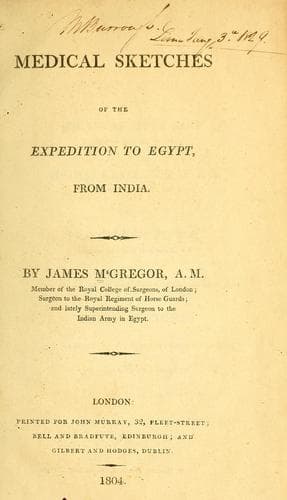
Medical Sketches of the Expedition to Egypt, from IndiaMcGrigor, James, Sir
History
Medical Sketches of the Expedition to Egypt, from India
McGrigor, James, Sir
Great Britain. Army -- Sanitary affairs; Medicine, Military
The 80th regiment came from Trincomalée, in Ceylon, a very unhealthy
station, and where, during a five-years stay, they lost a very great
number of men. This regiment was very healthy on landing. It was composed
of what are usually termed old Indians; draughts from the 36th, 52d,
71st, and 72d, regiments, which had been sent home after a stay of
fifteen or twenty years in India. The 80th suffered most of their loss
after crossing the desert. At Ghiza, at El Hammed, and at Alexandria,
they were the most healthy corps. However, there were many old men in
this regiment who never recovered the fatigue of the march, nor the
illness at Rhoda island, and who felt most severely the cold weather at
Alexandria. A fact regarding this corps deserves mention. Mr Brown, who
was in charge of it, informed me, that many men, who, at Trincomalée,
were never free from liver-complaint, and were almost always in the
hospital with this disease, never complained at Alexandria. This fact, on
inquiry, I found held good in most other corps, and I had observed many
instances of it in the 88th regiment.
The 86th regiment landed in a healthy state. This regiment had been six
years in a warm climate. They came from Bombay, where they had been in
garrison for the two last years. They continued very healthy till they
were encamped at Rhoda island; there, and at El Hammed, they suffered
much: subsequently, no corps in the army suffered less or lost fewer. The
frequent movements of this corps contributed to their being in a more
healthy state than some other corps were.
The 88th regiment had been about three years in a warm climate. They
likewise came from Bombay. This regiment crossed the great desert with
the loss of only one man. They were very healthy at Ghenné, and continued
so till their arrival at Rhoda. The 88th was the first regiment from the
Indian army that arrived at Ghiza, where they found the 89th regiment,
and the ophthalmic hospital of the English army. In the course of the
first week after their arrival at Ghiza, the 88th regiment sent one
fourth of their strength into the hospital; all of them cases of fever or
ophthalmia. At El Hammed, in proportion to the strength of this corps,
ophthalmia prevailed more in it, and the regiment suffered more from it,
than any other corps, except the 10th regiment. It will be remembered,
too, that it was in the 88th regiment that the plague first broke out;
and this regiment had more cases and more deaths from it than any other
European corps. Mr Tonrey and myself, who attended these first cases,
were among the few medical men who were exposed to the contagion and
came in contact with the patients, and yet escaped the disease. The 88th
regiment became at last one of the most healthy corps in the army. From
the 1st December, 1801, to the 1st May, 1802, they only lost two men; of
these, one was from the plague, and the other from sudden death, cause
unknown.
Public-domain text, read in full here on John Shaqi.
Reviews
Reviews
No reviews yet
Be the first to share your thoughts on this work.
Join the Discussion
Join the discussion
Sign in to leave a comment or review.
Sign InorCreate an account