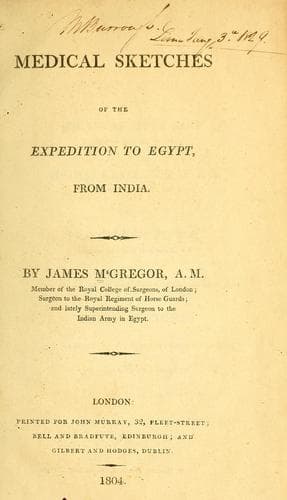
Medical Sketches of the Expedition to Egypt, from IndiaMcGrigor, James, Sir
History
Medical Sketches of the Expedition to Egypt, from India
McGrigor, James, Sir
Great Britain. Army -- Sanitary affairs; Medicine, Military
4thly, The glandular affection was the next most generally attending
symptom. Not above one-half of Mr Whyte’s cases had buboes; and, in
a great majority of Mr Rice’s patients, this symptom did not appear.
Dr Henderson says, that, in every one of his cases, there was either
inflammation or swelling of the glands. The glands most commonly
affected were the femoral, next the axillary, then the parotid,
submaxillary, &c. In one case of Mr Adrian, an abscess, of the size of
a pigeon’s egg, formed on the inner canthus of the left eye. Mr Adrian
opened it by incision, and the patient did well. Many were surprised
at the rapidity with which the appearance of bubo followed the first
complaint of illness: in a number of cases, within four hours. Mr Rice,
on the 7th of January, admitted five cases, and in none of them were
buboes later of appearing than six hours after the first feeling of
illness. In a Sepoy of the 7th regiment, taken ill in December, the
femoral axillary, parotid, submaxillary, and sublingual, glands were all
affected. In another Sepoy of the same regiment, admitted by Mr Rice,
a case of re-infection, so very much swelled were the glands about the
neck, that the man died of suffocation the day on which he was admitted.
5thly. The next most generally-attending symptom was the affection of
the abdomen. Mr Price says, the hepatic region was in every instance
affected. Sometimes there was a swelling of the region of the liver, pain
was experienced from pressure, sometimes in the epigastric, sometimes in
the hypogastric, region; and almost always in the region of the liver, at
which time, the pain has in some cases extended to the kidneys. Swelling
of the belly was very frequent; in some cases the abdomen appeared a
mass of knots. Uneasiness at the precordia, nausea, and vomiting, were
frequent: the vomiting was always of bile, which was of different colours
in different stages of the disease. Mr Price writes, “costiveness was
a constant and obstinate symptom; and, when ten or twelve grains of
calomel brought fæces down, they were always accompanied with bile; first
brown, then yellow.” The urine was in general yellow; the skin and adnata
frequently of the same colour. Mr O’Farrel says, “I lost one of the
dragoons from the affection of his side; the fever went off some days
before his death.” Mr Adrian writes, “I do not find the constipation
an universal symptom, although, in many cases, I have met with it very
obstinate. I was once obliged to give eighteen grains of calomel and two
scruples of cathartic extract before my patient was moved.” In several
cases, the disease commenced with diarrhœa or dysentery. Some of Mr
Thomas’s patients died of dysentery; and this might have been said to be
the cause of their death, as they recovered from the bubo, fever, and
other symptoms of plague.
6thly. In the first part of the season, petechiæ, vibices, maculæ, and
carbuncles, were not seen: in the middle of the season they frequently
appeared.
Public-domain text, read in full here on John Shaqi.
Reviews
Reviews
No reviews yet
Be the first to share your thoughts on this work.
Elsewhere in the archive
Join the Discussion
Join the discussion
Sign in to leave a comment or review.
Sign InorCreate an account