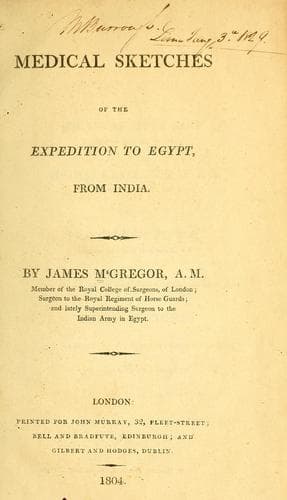
Medical Sketches of the Expedition to Egypt, from IndiaMcGrigor, James, Sir
History
Medical Sketches of the Expedition to Egypt, from India
McGrigor, James, Sir
Great Britain. Army -- Sanitary affairs; Medicine, Military
7thly. Some gentlemen could distinguish the disease by a particular look
of horror and by a particular cast of the eye, which was first watery,
next blood-shot, and at last yellow.
8thly, According to the diversity of the season, the pulse varied. In
general, it was small and frequent, and often, when at the wrist it was
not perceptible, it could be felt beating 130 or 140 at the carotids.
9thly, The tongue was universally white at the edges; and, when in March
and April, some cases appeared with the fever of the typhoid form, it was
black and furred in the centre.
10thly, Several of the cases, which came under Mr Grisdale’s care in
February and March, had cough and dyspnœa. Mr Adrian makes a similar
report at the above period, and three of Mr Whyte’s patients at Rahamania
had cough and dyspnœa.
11thly, In a majority of Mr Price’s cases, he remarked an unusual dryness
of the skin, and that it was with the utmost difficulty that he could
ever excite perspiration. Mr Whyte says, that, “At Rahamania the skin
was dry, and that he had never succeeded in exciting sweating.”
These are the appearances the disease put on in the last season; and, on
inquiry, I find that they were the appearances it assumed in the former
season in the British army in Egypt.
My friend, Dr Short, who resided some time in Persia, and who has paid
much attention to the history of the plague, informed me, that, in
addition to the above, he found hemorrhage a frequent symptom in the
plague, which raged at Bagdad in 1800 and 1801.
In one case he saw a copious hemorrhage from the eyes, which continued
for nearly twelve hours. As soon as it stopped, an eruption appeared over
the body very much resembling the measles. This patient, a boy of twelve
years old, died on the 5th day of the disease.
The duration of the disease in different persons was very different. In
several instances, the effect of the pestilential contagion was the
immediate extinction of life; and we had several instances of the patient
surviving but a few hours the first sensation of illness.
The muccadum of the dooley-bearers of the 88th regiment, about nine
in the morning, exhibited the symptoms of fever. About twelve, a bubo
appeared, and he died before four o’clock. In some instances, again, the
patient lived till the thirteenth and seventeenth day of the disease;
however, these instances were rare.
Prognosis. We found that the greatest caution was requisite in giving
an opinion as to the probable event of cases: in no disease was the
practitioner oftener deceived. In several instances, patients who had
recovered from the fever, whose buboes were doing well, and people who
were convalescent, suddenly dropped down and expired. Whether this was
from re-infection, or whether it was a feature of the disease; will be
difficult to determine.
Public-domain text, read in full here on John Shaqi.
Reviews
Reviews
No reviews yet
Be the first to share your thoughts on this work.
Elsewhere in the archive
Join the Discussion
Join the discussion
Sign in to leave a comment or review.
Sign InorCreate an account