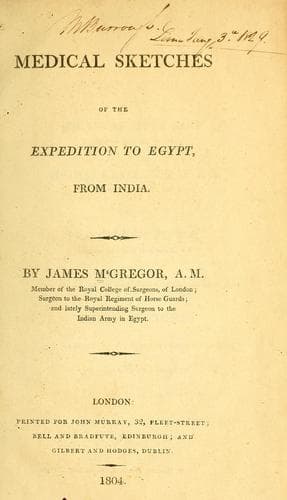
Medical Sketches of the Expedition to Egypt, from IndiaMcGrigor, James, Sir
History
Medical Sketches of the Expedition to Egypt, from India
McGrigor, James, Sir
Great Britain. Army -- Sanitary affairs; Medicine, Military
From the nature of the prevailing diseases, the campaign in Egypt was,
in a particular degree, a service of danger. To their regret, the Indian
army arrived too late in Egypt to share in any other dangers than
those arising from the diseases of the country; and here, the medical
gentlemen had the post of honour. The zeal, attention, and perseverance,
displayed, particularly by those employed in the plague-establishments,
deserve every praise. Nothing can so powerfully incite the exertions
of medical men, in such circumstances of danger, as the consciousness
of co-operating with the best and most enlightened of mankind, for the
alleviation of human misery. Intrepidity is more a military than a
medical virtue; but seldom I believe has there been a greater display of
it than among the medical officers, in Egypt, whose duty it became to
reside in the pest-houses.[1]
There are two names which I cannot pass over with general praise. At
a period of universal alarm, and of real danger, when the plague was
committing the greatest ravages, two gentlemen stepped forward, and
generously volunteered their services in the pest-houses. It so happened,
too, that, from their acquirements, these two were the best calculated,
of any in the army, to succeed in this dangerous duty. Dr Buchan had
acquired a perfect knowledge of the disease in the former year; and while
on duty at the pest-house, at Aboukir, had got the infection there,
soon after the memorable landing of Sir Ralph Abercrombie. Mr Price
had made the history of the plague his particular study, and, from his
acquaintance with the oriental languages, was peculiarly calculated to be
master of every thing relating to it. As will be seen hereafter, in the
execution of his duty at El-Hammed, he, likewise, caught the infection.
To the exertions of these two gentlemen, the service owes much; their
country very much. I would fain hope, that from them, who are so able to
do it, we may look for something like a history of the plague in Egypt.
Dr Shapter, who was for some time in charge of the medical department of
the Indian army, and who succeeded Mr Young, as head of the medical staff
of the English Army, deserves our thanks for his very ready accommodation
on every occasion, and compliance with every request for assistance, and
for many things, of which an army which had traversed an immense desert
was necessarily destitute.
Thus far I have discharged debts which I felt that I owed. I must add a
few words more, in explanation.
Public-domain text, read in full here on John Shaqi.
Reviews
Reviews
No reviews yet
Be the first to share your thoughts on this work.
Join the Discussion
Join the discussion
Sign in to leave a comment or review.
Sign InorCreate an account