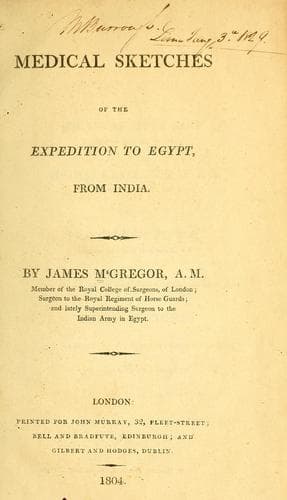
Medical Sketches of the Expedition to Egypt, from IndiaMcGrigor, James, Sir
History
Medical Sketches of the Expedition to Egypt, from India
McGrigor, James, Sir
Great Britain. Army -- Sanitary affairs; Medicine, Military
Ophthalmia prevailed most in the 61st regiment; after them, in the 86th
regiment: while the 8th dragoons, the artillery, and the 80th regiment,
had very little of the disease.
It was remarked, at all times, that the disease was seen much less
frequently, and with less violence, in the native Indian, than in the
European, corps. Of the former, the 1st Bombay regiment had much more
ophthalmia than any other corps of natives. It was said, that, in the
English army, the disease prevailed most in the dragoon-regiments. The
26th dragoons was mentioned as a particular instance of this: that corps
alone, I heard, sent home about 40 invalids from ophthalmia.
Several gentlemen thought that this disease, in Egypt, was contagious.[6]
So singular an opinion I would hesitate to offer on slender grounds.
However, the remarkable prevalence of the disease in particular
regiments, and even in particular companies of regiments, while the same
general causes prevailed every where, will not be easily accounted for,
without admitting something of the kind. In some corps of the army from
England, as well as that from India, this was observed. In the 54th
regiment, my friend, Mr Ross, then the surgeon of it, informed me that
the disease was for some time not only confined to particular companies,
but to particular tents. It deserves mention, too, that, till the
arrival of the Indian army at Ghiza, ophthalmia did not appear in the
army. We found at Ghiza the 89th regiment and an ophthalmia-hospital of
the English army.
I believe that several diseases are contagious, which are not suspected
to arise from such a cause: the theory of contagion is but very
imperfectly understood.
It was said, that the sailors, on-board the fleet at Aboukir-bay, had the
disease at the same time that it prevailed in the army on-shore. Several
cases appeared among the troops after we sailed from Suez.
Ophthalmia prevailed most from May to December. At Kossier the disease
was hardly seen, nor at Ghenné. It was not till the army was encamped
at Rhoda, in August, that cases crowded in on us. In that, and the two
following months, most of the cases made their appearance.
It will be seen, in part the first of these sketches, that, in the months
of January, February, March, and April, very few cases appear in the
reports.
About the middle of May the disease began to appear in Alexandria.
Public-domain text, read in full here on John Shaqi.
Reviews
Reviews
No reviews yet
Be the first to share your thoughts on this work.
Elsewhere in the archive
Join the Discussion
Join the discussion
Sign in to leave a comment or review.
Sign InorCreate an account