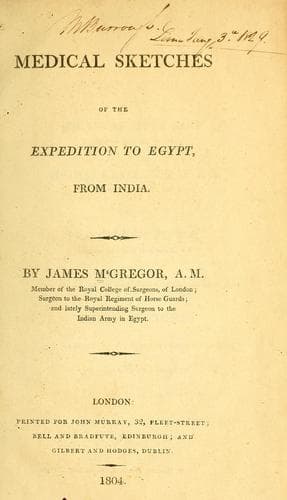
Medical Sketches of the Expedition to Egypt, from IndiaMcGrigor, James, Sir
History
Medical Sketches of the Expedition to Egypt, from India
McGrigor, James, Sir
Great Britain. Army -- Sanitary affairs; Medicine, Military
Some of our medical gentlemen thought this disease very different from
the ophthalmia which they had seen in Europe or in India. In several
circumstances there certainly was a difference, and we were obliged
to have recourse to a different mode of treatment, finding we did not
succeed with that pursued in England or in India. The disease, I think,
might generally be resolved into, 1st, either of Cullen’s two species,
the ophthalmia tarsi and the ophthalmia membranarum; 2ndly, to a
combination of these two; or, 3dly, to a species of ophthalmia, frequent
in India, symptomatic of disease in the biliary secretion.
The appearance which the disease put on, particularly the two first
species of it, was nearly what we have seen in other parts of the world;
except that the symptoms advanced with alarming rapidity to the highest
inflammatory stages. In most cases the attack was sudden, and very
generally at night. Speedily, the patient complained of a burning heat
of the eye-ball, or of a sensation of needles being passed through the
eye. There was a considerable swelling of the ball of the eye, of the
eye-lids, and sometimes of the neighbouring parts. Almost always, there
was a copious flow of tears, which felt hot and scalding, and, as they
flowed down, excoriated the face. Very frequently, there was a racking
headach and general fever. Œdema of the eye-lids was frequently met with
in the early stage of the disease, and inversion of the cilia in the last
stages.
The disease very often continued two or three months: after it had
continued some time, the general health became much impaired. It often
terminated in diarrhœa or dysentery, and sometimes the patient became
hectic.
In the third species of the disease, which I have mentioned, there was
not so much active inflammation as in the other two species; and it was
generally known by a yellow tinge of the adnata, or by dyspeptic symptoms
being present; though, sometimes, we have seen those appearances absent:
and no topical application had any effect in removing the ophthalmia,
till the gums were affected by calomel or some mercurial preparation.
In the two first species of the disease, the inflammation, in a great
many instances, induced fever of many days duration, and the disease too
frequently terminated in opacity of the cornea or in suppuration of the
eye-ball.
In the treatment, it appears, from the reports, that different gentlemen
followed very different modes. We said, in general, that the European
practice did not succeed. Scarification and astringent collyria, in the
first stage, gave intolerable pain, and generally aggravated the symptoms.
Public-domain text, read in full here on John Shaqi.
Reviews
Reviews
No reviews yet
Be the first to share your thoughts on this work.
Elsewhere in the archive
Join the Discussion
Join the discussion
Sign in to leave a comment or review.
Sign InorCreate an account