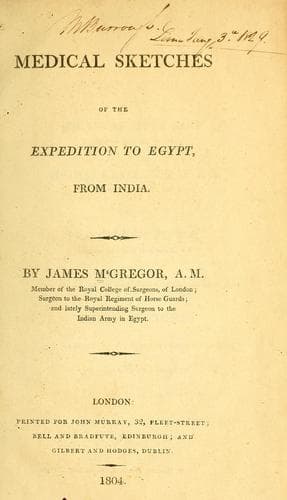
Medical Sketches of the Expedition to Egypt, from IndiaMcGrigor, James, Sir
History
Medical Sketches of the Expedition to Egypt, from India
McGrigor, James, Sir
Great Britain. Army -- Sanitary affairs; Medicine, Military
In Egypt several causes occurred, which in any country, separately
applied, would be adequate to the production of violent ophthalmia. The
dry, white, dazzling, soil, and the fine sand and dust constantly thrown
about in whirlwinds and entering every crevice. If an ophthalmia is
epidemical or is endemic in Egypt, the above causes will render it a very
violent disease.
But I conceive, that, of themselves and alone, these circumstances do
not produce the violent ophthalmia seen in Egypt. In no place did these
circumstances exist in greater force than at Kossier, on the march across
the Great Desert, and at Ghenné. Yet, till our arrival at Ghiza, the
disease did not appear. These circumstances likewise exist in great force
in most places of India, where the ophthalmia occasionally occurs from
them, yet it is different from the two first species of the Egyptian
ophthalmia.
For the production of the third species of this disease, the same causes
will account, which produce dysentery, hepatitis, and other diseases of
the liver. In Egypt, I remarked, that most of the cases of this species
occurred at the time that dysentery prevailed the most.
It should be mentioned, that, in Egypt, the natives are universally
impressed with the idea, that sleeping in the night-air brings on the
disease.
In the ophthalmia of Egypt, as in the plague, it would appear, that very
much may be done in the prevention.
It could not escape observation, how rarely officers were the subjects
of this disease. In accounting for this, I lay most stress on the
attention which officers pay to cleanliness. In the 88th regiment, where,
I believe, forty men did not escape an attack, only two officers out of
thirty had ophthalmia.
In the whole of the Indian army, only one officer lost an eye by it, and
this was Ensign Paton, of the 86th regiment.
The exemption of the officers from the ophthalmia gives more weight to
the opinion, that in Egypt this disease is communicated by contagion.
Mr Paton, previously to embracing the military profession, had studied
medicine; and, when medical assistance was much wanted, and a great many
of his corps were laid up with the ophthalmia, he very humanely offered
to attend them. When employed in this duty, he was himself attacked with
the disease and suffered most severely by it for many months.
Mr Bellars, about this time, joined the 86th regiment at Ghiza; he took
charge of the sick, and was attacked in the same manner as Mr Paton had
been, and he likewise suffered most severely by it for several months.
Public-domain text, read in full here on John Shaqi.
Reviews
Reviews
No reviews yet
Be the first to share your thoughts on this work.
Elsewhere in the archive
Join the Discussion
Join the discussion
Sign in to leave a comment or review.
Sign InorCreate an account