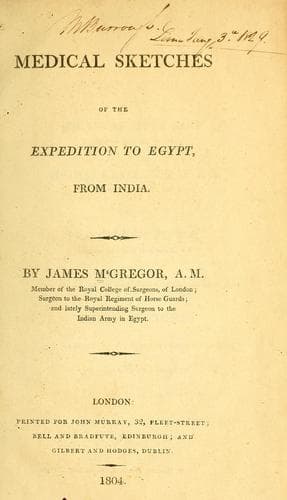
Medical Sketches of the Expedition to Egypt, from IndiaMcGrigor, James, Sir
History
Medical Sketches of the Expedition to Egypt, from India
McGrigor, James, Sir
Great Britain. Army -- Sanitary affairs; Medicine, Military
The practice of the natives, was, to apply, in the first stage, emollient
decoctions of their plants, and poultices of the kali. In the last
stage, they rely much on the frequently bathing of the eye in the cold
water of the Nile: they are likewise very fond of bleeding; and I
understood that sometimes they use the actual cautery, burning behind the
ear where we usually apply blisters.
The practice, which appeared to be by far the most successful, was the
following:
For the first twenty-four or thirty-six hours after admission, the eyes
of every patient were carefully syringed with tepid water, which had been
filtered carefully. The syringing was performed from three to six times
in the day; the light was carefully excluded, the patient kept cool, and
every other part of the anti-phlogistic regimen strictly enforced. After
the above period, a weak solution of sugar of lead, or of camphor, or
vitrolated zinc, was applied. Where the pain was much complained of, a
solution of opium was added to the collyrium; opium was applied in a
cataplasm, or two or three drops of laudanum were let fall into the eye.
If there was much swelling, a saturnine poultice, or the coagulum
alluminosum, was applied to the eyes. I observed, that blistering a
large surface, and as near as possible to the seat of the pain, if kept
discharging for some time, always afforded great relief.
To remove the fever and to alleviate the distressing pain, we often gave
opium internally in a considerable quantity, and with great advantage.
Setons in the neck and the free use of bark appeared to be of the
greatest service, when the disease was of long standing.
In opacity of the cornea, and when there were specks, several gentlemen
thought highly of the aqua phagedænica of the old pharmacopeias, after
having divided the vessels which went to the speck. It gave very pungent
pain; but I have seen great relief from it, and also from a solution of
lunar caustic.
As a collyrium in Egypt, I often gave with considerable benefit what I
found in the hands of the black doctors in India, viz. a tea spoonful of
lime-juice to four table spoonfuls of water, or a tea spoonful of arrack
to two table spoonfuls of water. In the first stage, I would have applied
leeches, but never could procure them.
In Persia, Dr Short, informs me, that he was very successful in the
general use of an ointment, composed of white vitriol, tuttey, and
cinnabar, after the application of leeches and scarification.
From the days of Prosper Alpinus, the salts contained in the soil
of Egypt have been supposed to be among the principal causes of the
ophthalmia of the country. Though the various modifications of light
and heat no doubt act as existing causes; yet to the particular soil of
Egypt, and to the constitution of the air there, we must look for the
regular and the principal causes of this disease.
Public-domain text, read in full here on John Shaqi.
Reviews
Reviews
No reviews yet
Be the first to share your thoughts on this work.
Elsewhere in the archive
Join the Discussion
Join the discussion
Sign in to leave a comment or review.
Sign InorCreate an account