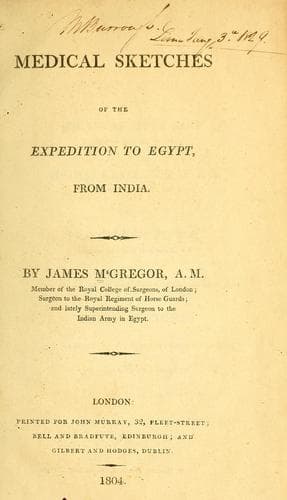
Medical Sketches of the Expedition to Egypt, from IndiaMcGrigor, James, Sir
History
Medical Sketches of the Expedition to Egypt, from India
McGrigor, James, Sir
Great Britain. Army -- Sanitary affairs; Medicine, Military
The fever which we had in Egypt, at different stations and in different
seasons of the year, assumed various types. That which, on the outset,
prevailed among the Bombay Sepoys, was remittent. At Ghenné, the fever
in the 10th regiment was continued; but it very often terminated in
hepatitis. At Ghiza, we have said that we suspected contagion as the
cause, at first; but, in the end, the disease was clearly kept up by
marshy effluvia on Rhoda Island. It assumed a remittent, and sometimes an
intermittent, form, when brought down to Rosetta; and many of the cases
terminated in dysentery. At El Hammed, a majority of the fevers which
occurred were intermittents; but several remittents occurred, and a few
cases which had some resemblance to typhus. After October, fever was
a disease of rare occurrence. In the last general return for November,
fifty cases appear, of which thirty-four were natives of India. The last
return in December is much the same, the native corps having a majority
of the cases.
In the last return of January there appear, of continued fever,
twenty-two cases; twelve of whom were Europeans. Of intermittents there
were thirty-two cases, and sixteen of them were Europeans. In the general
report of the 26th of February the total of fever in the army is only
twenty-three, and of them, only six are natives. On the 26th of April, we
had only fourteen cases, of which three were natives. In May, fever did
not appear in the reports.
Though fever, as it appeared in the Indian army in Egypt, at different
periods, occurred with some variation; and though particular symptoms
called for occasional variation in the treatment; yet, in its general
character, the disease was the same, the proximate cause appeared to be
the same, and the same general indication was required to be kept in view
in the cure. I am inclined to believe, that, under different names, the
same fever prevails over the peninsula of India, and over the eastern
islands; and, perhaps, I might venture to extend the remark to the
countries between the tropics. This fever has been often well described,
under the name of the remittent fever of Bengal. Dr Lind, of Windsor,
several years ago, gave an excellent and concise account of it in his
Thesis. In Bengal, it is known under the name of the pucca fever. In
Madras and on the Coromandel coast, it is the jungle fever. At Bombay and
on the Malabar coast, it is known under the same name. In the army in the
Guzzerat country, to the northward of Bombay, it is this fever which has
proved so destructive of late to our army in the field there, opposed to
the Mahrattas. In the island of Salsette, near Bombay, it pays an annual
visit, on the ceasing of the monsoon, and proves very destructive. In
1801, on one estate, in Salsette, upwards of forty people were attacked
with this fever in one night. I have learned from my ingenious friend Mr
Christie, surgeon-general of Ceylon, that it was from the same fever,
Public-domain text, read in full here on John Shaqi.
Reviews
Reviews
No reviews yet
Be the first to share your thoughts on this work.
Elsewhere in the archive
Join the Discussion
Join the discussion
Sign in to leave a comment or review.
Sign InorCreate an account