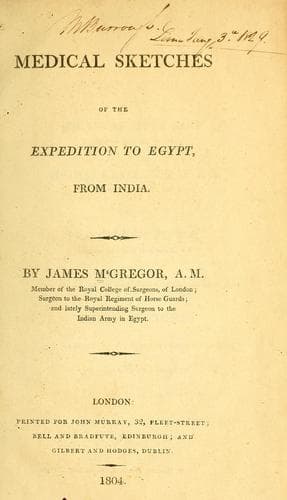
Medical Sketches of the Expedition to Egypt, from IndiaMcGrigor, James, Sir
History
Medical Sketches of the Expedition to Egypt, from India
McGrigor, James, Sir
Great Britain. Army -- Sanitary affairs; Medicine, Military
that the 19th, 51st, and 80th regiments, have been so very much reduced;
and that it was this fever which proved so destructive in the late war
with the king of Candy. Mr Christie writes me, that in its destructive
malignancy and ravages, particularly on the Europeans in Ceylon, it has
equalled the yellow fever of the West Indies.
From many accounts of it, which I received while in India, I am
convinced, that the dreadful fever which prevails in Batavia is the
same disease. In Batavia, the mortality from this fever is prodigious;
it is not exceeded by that from the plague in Egypt, or from the yellow
fever in America. Different circumstances, it would appear, concur to
the production of the disease, in a very aggravated form, in the Dutch
settlement of Batavia; of which, we may mention the extreme unhealthiness
of the situation, and the bad practice of the Dutch surgeons.
Dr Griffith, surgeon to the naval hospitals in India, informed me, that,
when our fleet lay off Batavia, in 1801, it prevailed very much; but
that, when they got the management of patients early, they were generally
successful in the treatment of the disease. Bencoolen is one of the most
unhealthy of our eastern settlements, solely from the prevalence of this
fever. In China, it appears likewise to be a frequent and fatal disease.
Having said thus much on the identity of the fever which appeared in
Egypt, with that which is seen in India, and in the eastern islands, I
shall proceed to the treatment. The first step was to cleanse the primæ
viæ, and some gave emetics: this, however, was not always necessary;
and purging with calomel, and the neutral salts, appeared in most
cases to answer the same intention. In the first stage, likewise, as
particular symptoms called for them, venæsection was performed, blisters
were applied, we determined to the skin, or gave opiates. However, if
the fever was of any duration, the practice always was, to endeavour
to affect the mouth as speedily as possible with mercury. This was the
practice in continued fever, and in Egypt, as in India, we were very
generally successful, if application was early made. In the destructive
fever of Ceylon, Mr Christie says, that he has practised but with a
moderate share of success: but that the affecting the system by mercury
is by far the most successful of different modes of treatment which he
had tried. He gave nitric-acid, but in a very small quantity. In the
fleet, when stationed near Batavia, Dr Griffiths gave mercury more
liberally than any practitioner I know. He likewise used the nitric-acid
very freely, both externally and internally, and relied much on its
combined use with mercury. By two very able practitioners, Dr Keir and Mr
Stewart, the Salsette fever has been successfully treated by nitric-acid
alone; purgatives having been previously exhibited. Some practitioners
treated intermittents by bark, some by opium, or by giving this and
the volatile alkali.
Public-domain text, read in full here on John Shaqi.
Reviews
Reviews
No reviews yet
Be the first to share your thoughts on this work.
Elsewhere in the archive
Join the Discussion
Join the discussion
Sign in to leave a comment or review.
Sign InorCreate an account