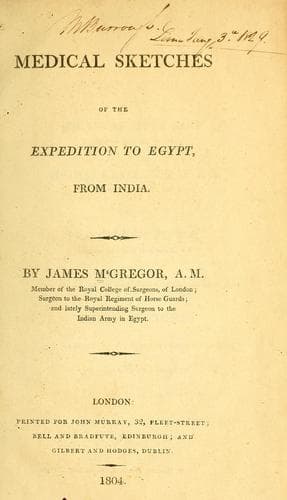
Medical Sketches of the Expedition to Egypt, from IndiaMcGrigor, James, Sir
History
Medical Sketches of the Expedition to Egypt, from India
McGrigor, James, Sir
Great Britain. Army -- Sanitary affairs; Medicine, Military
To whom the world is indebted for the successful treatment of hepatitis
by mercury, I cannot correctly say. The oldest written account of this
practice, that I have seen, is in a very sensible pamphlet by Dr Paisley,
formerly of Madras. There is another very distinct account of it in a
pamphlet by Dr Girdlestone, of Yarmouth, formerly surgeon of a regiment
in India.
For the general introduction of mercury, through the western side of the
peninsula of India during the last twenty years, for the application of
nitric acid to the same purpose, and for the discovery of some other
preparations analogous to these, we are indebted chiefly to the ingenious
Mr Scott, of Bombay. About ten years ago, from some experiments which he
made on the calces of mercury, he discovered the analogy between them
and nitric acid, and he was the first to apply this acid to the cure of
hepatitis. Subsequently, he was led to the use of nitric acid and other
analogous remedies in hepatitis and other diseases, which are curable
only by mercury, a practice, of which, on a large scale for the last six
years, I have observed the best effects, and which is now likely to get
into general use in India.
I have said, that the species of hepatitis which we met with, at last,
in Egypt, was not that usually seen in India, and a corresponding change
was required in the treatment. Previously to giving mercury it was found
necessary to premise the anti-phlogistic regimen.
In the use of mercury great address is often required; and, in
substituting nitric acid and the analogous remedies, I am convinced, that
much advantage may often be gained. Sometimes one of these remedies will
succeed when the other has failed; and not unfrequently have I seen their
combined use succeed where separately given they had failed. In obtaining
a new agent we have acquired a great deal more power in the management of
a disease, the most formidable to Europeans in the eastern world.
Sometimes in Egypt, and in many instances in India, I have observed, that
I could not affect the gums with mercury, or with acid, till venæsection
was performed. After this operation, I have often succeeded, and induced
a flow of saliva, in cases which had long resisted a liberal use of
mercury and nitric acid.
If the modern practice of giving but little mercury, and to make it only
touch the gums, as it is called, without exciting a flow of saliva, be
proper in the venereal disease, undoubtedly it is not in hepatitis. This
disease never yields till the saliva flows freely—the explanation of this
I do not attempt; but the fact is as I state it, and it is well known
to every man who has practised extensively in India. Whenever the gums
are hard, and insensible to the effects of mercury; when, instead of a
salivation, they are red, painful, spongy, or blue, the prognosis is
very unfavourable: in ninety of such cases out of the hundred we lose our
patients.
Public-domain text, read in full here on John Shaqi.
Reviews
Reviews
No reviews yet
Be the first to share your thoughts on this work.
Elsewhere in the archive
Join the Discussion
Join the discussion
Sign in to leave a comment or review.
Sign InorCreate an account