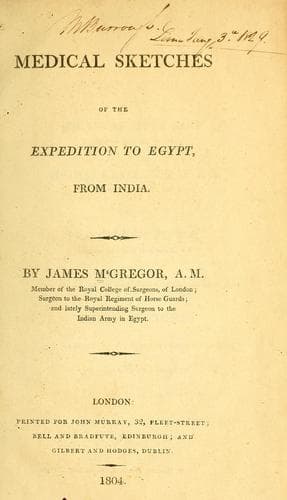
Medical Sketches of the Expedition to Egypt, from IndiaMcGrigor, James, Sir
History
Medical Sketches of the Expedition to Egypt, from India
McGrigor, James, Sir
Great Britain. Army -- Sanitary affairs; Medicine, Military
In India, the liver seems to be the seat of disease in nearly the same
proportion that the lungs are in England.
In Upper Egypt, and at Ghiza, we had many cases of hepatitis: it was the
same disease that we had seen in India. At Rosetta and Alexandria a few
cases did occur, accurately answering to Cullen’s definition of the acute
species. Sergeant Levi, of the 88th regiment, was one instance. On the
13th of October, he was admitted into the hospital with this disease in
a most violent degree. He had been ill only twenty-four hours: he had
high inflammatory fever; his side was extremely tender to the touch;
he had great irritability of stomach, and pain over the belly. He was
twice bled: the anti-phlogistic regimen was for thirty-six hours applied
in its utmost rigour: thereafter mercury was liberally thrown in, and
he recovered. We remarked that many, who, in India, were the frequent
subjects of repeated attacks of hepatitis, at length never complained,
or they had the disease in the mildest shape, in Egypt. After the month
of October, hepatitis was a disease of still more rare occurrence. In no
corps did the number of cases bear any proportion to what they were wont
to be in India.
During October a considerable number of cases occurred, but almost all of
them were Europeans: the proportion of the natives who had this disease
was always very small.
About the beginning of November several fresh cases occurred, and all of
them were acute.
By the end of December this disease was fast disappearing in the army. In
the last return of the month there were only twenty-one cases, and twenty
of them were Europeans.
In January it still continued to decline. In the return of the 31st of
this month there appear only nine cases, and all of them are Europeans.
In the first return of February there are only five cases, and all of
them are Europeans.
There was an increase in March. In the first return of the month there
were twelve cases, and all were Europeans.
In the last return of April the total number was so low as six, of which
number four were Europeans.
At the time of embarkation, at Suez, there was not one case reported in
the army.
Hepatitis appeared more in the Company’s artillery, and in the 10th
regiment, than in any other corps of the army. For its predominance in
the latter corps, one reason has been assigned, and which to me appears
to have had the most powerful influence.
But on the whole, this disease, once so formidable to us in India,
gradually ceased to appear in the returns of the sick.
The treatment of hepatitis it is unnecessary to dwell on: for no disease
are we provided with a more effectual or sure remedy. If the season for
applying the remedy be not lost, we are nearly, I think, as confident of
a cure by mercury, and the analogous remedies, as we are in a case of
syphilis by the same remedies.
Public-domain text, read in full here on John Shaqi.
Reviews
Reviews
No reviews yet
Be the first to share your thoughts on this work.
Elsewhere in the archive
Join the Discussion
Join the discussion
Sign in to leave a comment or review.
Sign InorCreate an account