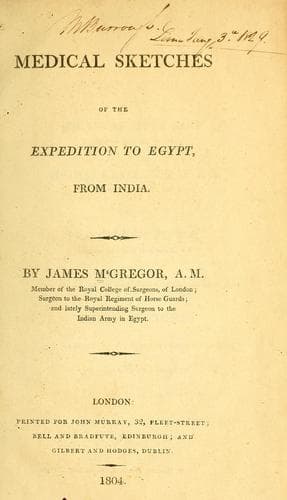
Medical Sketches of the Expedition to Egypt, from IndiaMcGrigor, James, Sir
History
Medical Sketches of the Expedition to Egypt, from India
McGrigor, James, Sir
Great Britain. Army -- Sanitary affairs; Medicine, Military
The dysentery which occurred in the army till we came to the shores of
the Mediterranean, and for some time after, was clearly the dysentery of
India; but, afterwards, we witnessed a different disease. I must confess,
that, having come to so certain a conclusion, I was not ready to give
up an opinion which appeared to me to rest on very sure grounds; and it
was not till after much doubt, hesitation, and careful observation, that
I became convinced, in Alexandria, that, with the change of country and
climate, we had a different disease. This is one proof how improper, and
how unsafe, it is for the practitioner of one climate to sit down and
describe the diseases of another. They only who have studied the same
diseases, in various and opposite climates, can fully comprehend the
extreme absurdity as well as fallacy of this. From reasoning of any kind,
we are incompetent to decide on the identity of disease. Reasoning from
analogy here always deceives. In many of the symptoms diseases may agree;
but, from thence to infer their identity is taking a very narrow view.
The comparison will be found to hold good only in some points, and that
we have satisfied ourselves with an imperfect outline. Between diseases,
as they occur in Europe and in Asia, there are just as many shades of
difference as between the plants of those opposite regions, or in the
colour of the inhabitants.
The dysentery of India, or what I shall term the tropical dysentery,
is not the disease which is described by Cullen under that name. The
dysentery of Cullen, as it is faithfully described by Sydenham, Pringle,
Monro, and Sir George Baker, is a frequent disease on the continent of
Europe; and it has ever been a most destructive disease in our armies
there. The dysentery of Europe I believe to be generally a disease of
the intestinal canal. I have already said that the tropical dysentery
proceeds from a different cause; but the diseases likewise differ much
in their symptoms. The “pyrexia contagiosa” certainly forms no part of
the tropical dysentery; and the torminia and tenesmus occur so rarely,
that, in a definition of this disease, I presume they cannot be admitted.
Spasmodic affection of the intestinal canal, I believe, rarely occurs in
the tropical dysentery.
I have ever experienced difficulty in distinguishing dysentery from
diarrhæa, and am inclined to think, that, in Cullen’s definition of
diarrhæa, is described tropical dysentery. The diarrhæa biliosa, as well
as his seventh species, the diarrhæa hepatirrhea, perhaps, ought to be
included in a definition of tropical dysentery.
Public-domain text, read in full here on John Shaqi.
Reviews
Reviews
No reviews yet
Be the first to share your thoughts on this work.
Elsewhere in the archive
Join the Discussion
Join the discussion
Sign in to leave a comment or review.
Sign InorCreate an account