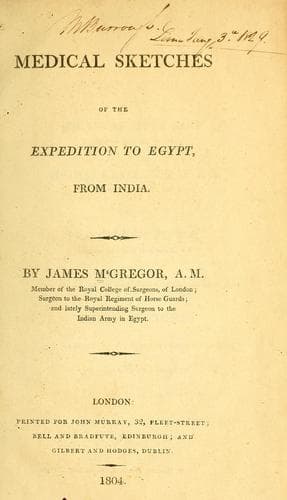
Medical Sketches of the Expedition to Egypt, from IndiaMcGrigor, James, Sir
History
Medical Sketches of the Expedition to Egypt, from India
McGrigor, James, Sir
Great Britain. Army -- Sanitary affairs; Medicine, Military
It has been already mentioned, that it was the tropical dysentery which
principally prevailed in the army. Though I was not convinced that we had
a different disease, till after we came to Alexandria, yet I am inclined
to think that it was the European disease which chiefly prevailed in the
army for some time before; and, if we draw the line from November, we
shall not be far removed from the truth.
It will not be necessary to say much in the treatment of tropical
dysentery. Mercury is now the remedy relied on every where. In Egypt, we
felt the want of nitric acid in hepatitis; and we equally felt the want
of this powerful remedy in dysentery. The instances which have occurred
to me, during the last five years, are extremely numerous, where,
after our failure with mercury, exhibited in all the variety of its
preparations, we succeeded with this remedy sometimes as a substitute,
and sometimes as an auxiliary.[7]
It was in the 61st regiment that cases of the dysentery of Europe were
first observed. Perhaps it more readily appeared in this corps, because
the greatest part of the men had not yet got rid of the European habit,
and were as yet unassimilated to a warm climate. After repeated failures,
and losing some men, Mr Ruxton saw the necessity of giving trial to other
remedies than mercury.
The disease generally set in with a smart fever, and, unless the calomel
exhibited went through the bowels, the patient felt no relief: and Mr
Ruxton remarked, that the neutral salts gave this relief much more
perfectly than calomel. The treatment which Mr Ruxton rested on, and
with which he was at length successful, was, in most cases, putting the
patient on the anti-phlogistic regimen; frequently giving laxatives; and
keeping up a determination to the skin. The same practice was followed in
the few fresh cases which occurred in the 88th regiment at Alexandria,
and in a considerable number of cases in the hospital of the 10th
regiment, and some other corps. However, it must be mentioned, that to
the last period some cases did occur, in all these corps, where calomel
was found necessary. When the disease was of some weeks standing, and
where a chronic disease occurred, calomel given in small doses proved the
best and indeed only useful remedy.
For a long time, we saw but little dysentery in the army. The number
of cases which occurred, before we arrived in Lower Egypt, was
inconsiderable.
Public-domain text, read in full here on John Shaqi.
Reviews
Reviews
No reviews yet
Be the first to share your thoughts on this work.
Elsewhere in the archive
Join the Discussion
Join the discussion
Sign in to leave a comment or review.
Sign InorCreate an account